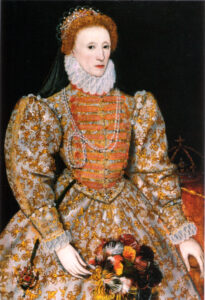
She leaned back on her throne and sighed. There was an ache in her lower back which would not go away. Perhaps John might have something to suggest. Meanwhile there was a susurrus of movement near the doors of her audience chamber. A long murmuring was running down the hallway outside. And there he was. An involuntary hand went to her mouth. He was limping, and he looked older than she remembered. Everyone spoke of his beauty, but this was fanciful. There was little enough beauty left in the man now. Everyone assumed that because he was a famous love poet, he must of necessity be as fair as the dawn. As a youth he had been, in her eyes, plain enough to look at. What shone in his eyes was a rare intelligence. Beautiful young men were commonplace. Though she loved them as much as any ageing maiden, she did not trust them. This one was a man of independent and fearless mind; a paragon of chivalry in truth. His nobility was famous across Europe. He had crossed her once over the French marriage, and had braved her legendary wrath with courage and discretion. He was going to need both qualities soon in full measure. But that was for tomorrow. Now, she would give him a memorable reception. As her lame warrior stuttered towards her, she rose. Instantly all the maids were on their feet also.
‘Sir Philip, you shall not kneel before Us,’ she proclaimed in her most commanding voice. ‘You are wounded in Our service, and this day you shall stand.’ She extended her right arm and felt his lips brush her rings. One of which (an Indian ruby set in gold) she detached and laid within his hand. ‘Now you must rest after your labours. Soon We shall summon you again.’ Sidney bowed from the waist, his hazel eyes registering surprise, gratitude and fear in successive instants. Now she saw him more closely, she realized why men thought him comely. Warmth, charm and sympathy radiated from his beardless face. This, she realized, was a man far changed from the Protestant fanatic she remembered. He blinked, bowed again, and began to limp back down the passage, still facing her as required. The whispers ran away into the hallway shadows. Prying eyes were everywhere, and her decision to waive her rights in the matter of kneeling was running outwards like ripples in a pond. Soon it would be known across her entire realm. Let them gossip as they may. As always, she did nothing without sound reasons of state. Meanwhile there were more guests to see to. If only her back did not ache so much.
During the late afternoon she contrived to have a quiet moment with John. She was seated in one of her more private chambers, lightly attended. She had longed to see him earlier, but open court would not do for this interview. That was the way of it, she had long ago decided. That which must be seen by the world’s eyes was for daylight. More confidential matters were for later on. She smiled down upon him and remembered how she had come under his spell. Bishop Bonnor had arraigned him, she remembered, during her sister’s reign. The man was a monster: unspeakably cruel and vicious even by the standards of an exceptionally violent age, and John had been in peril of his life. Yet somehow he had talked Bonnor round and become his ally. An ally of convenience only, of course. But that was what had attracted him to her. Any man who could do that was a wizard worth employing.
‘Rise, Dee, and report.’ She looked down along a massively bejeweled arm towards the small, balding man kneeling before her. What a beard! she considered, as she generally did whenever she saw him. Long, exhaustively tended, pointed and eminently appropriate for one popularly regarded as a magician. She knew better, of course, but the man was undeniably useful. He rose creakily, as if his joints ached. They probably did. So did hers. They were none of them as youthful and sprightly as they used to be.
‘The man is a fraud, Your Majesty.’ She inclined her head as regally as she could manage these days.
‘I did tell you so, did I not?’
The beautiful deep brown eyes blinked. They were the colour of oakwood, deep, wise and patient. His squeaky and accented voice was a strange contrast, but Dee was proud of his Welsh forbears. As indeed am I, she recalled.
‘Madam, you did so, and I am in your debt, as ever. Talbot he claims to be, but his true name is Kelley. I sought ever for knowledge, as Your Majesty knows.’ He began to mutter under his breath, but stopped short when he caught her disapproving eye. ‘Angelic conferences!’ he intoned with disgust. ‘The man knows less of angels than I of Cathay, and there is no truth in him.’ He began to pace up and down in vexation. She lifted a hand and waved to her maids of honour lurking around her chair. Up to no good, the whole lot of them. She saw Jane silently bring forward a small chair and place it pointedly before hers. She smiled frostily. A saucy slut, far too free with her favours for her exalted position. But she knew her mistress’ mind better than any of them. Otherwise she would long ago have been packed off home to Somersetshire to dally with shepherds and swineherds. Dee caught her eye, started guiltily and sat down, folding his neat, beautiful hands in his lap. ‘I most humbly beg your pardon, Majesty. I must deport myself more honourably than this. But for a man of learning to be so deceived –‘
‘John, you have rendered Us great service, and you need not stand upon ceremony. I believe I may guess the next part. You discovered that Count Łaski was also a fraud –‘ Dee’s eyebrows shot up, and she smiled thinly. Francis Walsingham had given her many details about Count Łaski and the real reasons for his absence from Poland. ‘And so you deemed it fruitless to learn any more of angels from these enterprising gentlemen. You set forth for England forthwith.’ He bowed his head silently. ‘And you went to Zutphen. May I ask why?’
Dee relaxed, now that his embarrassing failure in wisdom had been so expeditiously covered. ‘Pure chance, if chance we call it, Madam. I intended to sail from the Low Countries in any case, and I remembered that England has an army in Flanders. Your Majesty knows of Leicester’s gallant action there?’ She inclined her head again, and felt the gold and pearls of her necklace rest against her chin. What folly it all was. She was an old woman, decked out like the beauty she no longer was. Utterly essential for receiving foreigners, of course, but superfluous for old friends. Dee resumed after a short pause. ‘I found the battle over, and Sir Philip Sidney gravely wounded. I remembered the horoscope I had drawn for him long ago, predicting his death in this Year of Our Lord Fifteen Hundred and Eighty Six.’ He fell silent, and she smiled again. Faced with the choice of having his own prophecy proved wrong if he used his arts to heal the man, he had not hesitated. There could be little doubt that many astrologers were men of dubious virtue, but Dee was not so. Had not her ships covered the globe using his navigational mathematics? The way to tell with these wizards was ever and always the same. Had they succeeded in the life of the world? If not, why would you trust them with the Unseen when they experienced so much difficulty with the Seen?
Doctor John Dee lifted his beard and looked his Queen full in the face. ‘For my friend’s sake I put forth all my arts and healed him, Your Majesty. The Lord God of Israel was with me, and I required no angels.’
‘I am exceedingly glad that you did, John. Men die in wars. That is why I hate them. So many comely youths slain and wasted. But Philip I cannot spare. I have need of him.’ Great and desperate need, she added silently to herself. She rose, sinews creaking, and Dee was up from his chair in an instant. Her hand, barely to be seen beneath the golden rings on her fingers, reached out, and the mighty beard brushed over it. With her left hand she drew off one of the rings and laid it in his wrinkled palm. ‘I believe he waits without. Is this not so?’
Dee placed the ring on the fifth finger of his left hand and bowed deeply. ‘Shall I summon him, Madam?’ Seeing her nod, Dee bowed again and withdrew. She resumed her seat, while Jane and Lettice held her arms with trembling fingers. Lettice would be eager to be with her swain, and doubtless so would Jane. They would have to wait quite a while yet. She would dine with the miraculously resurrected Sir Philip Sidney and his father-in-law. Cecil would not like it, she knew. But while she relied on him in most matters, in this she would follow her own mind. The meal was good, she supposed, but she had no heart for it and barely noticed the dishes. But she was pleased to see Philip eating so heartily. Francis merely picked at his food and drank little. His adoring eyes were often upon her, and she did not mind this at all. Francis was neither young nor comely, but he adored her heart and soul. It warmed her ageing bones to witness it. Eventually the plates were cleared away, most of the maids departed, and her two guests looked at her expectantly.
‘Philip, I have a mind to scotch this nest of vipers. What say you?’ The three figures sat in carved wooden chairs by candle-light, now attended only by her two most discreet ladies in waiting. The candles sputtered and flared. Outside the window it was raining hard, and not even her own palace walls could keep out the freezing, prying wind. He looked carefully at her and considered.
‘They are Papists, Madam, and there is no truth in them. And yet… some among them are gentlemen of honour.’
‘Or even ladies of honour?’ She looked at the other man in surprise. Only in private would Francis be so indiscreet. After all, Philip was married to his daughter. To her surprise, Philip did not bristle. He turned his face directly toward her.
‘Indeed, Madam. There may be a reckoning one day with the Pirate Queen of County Mayo. She is a woman of extraordinary gifts, and you may find her something of a kindred spirit. But I did not speak of Grace O’Malley alone, Madam. The women of Ireland are a wonder of the world: fierce, proud, and loyal unto death. And there is fidelity in some of the chieftains also.’
Her eyes hardened. ‘Do not speak to me of O’Byrne,’ she commanded. ‘How many times must I pardon him?’
Sidney’s mouth curved in a frown. ‘There is little truth in Fiach McHugh O’Byrne,’ he pronounced. ‘He is a great warrior and leader of men; but a self-seeker only, for himself and his faction. I do not and will not trust him. But there are others, perhaps, whom we may convert to a more tractable attitude.’
Sir Francis Walsingham shook his head. ‘I advise against this, Madam.’ His hands clasped together as if in prayer, Walsingham’s bearded lips trembled. No other man was permitted to speak unbidden in the Queen’s presence, but he knew he was favoured. She looked kindly at the frail, worn-out figure. To the courts of Europe he was the feared spider at the heart of dark webs of intrigue. She knew better. All she saw was a tired mother hen, endlessly fussing over the safety of his wayward but adored chick. ‘The Irish natives are Papists, as Philip has reminded us. Their first allegiance is to the Bishop of Rome, and no promises made to heretics may be expected to bind them.’ He blinked again, and ran his calloused hands over his thinning brow. ‘They play us off one against another, and laugh in their beards behind our backs. Nothing now will serve but a show of strength in force, in their deepest glens where their chieftains plot against us. There must be no fraternizing with their nobles. One moment they are our faithful friends. And the next –‘ He held up his right hand and let it flutter in the candle-light.
She turned back to Sidney. ‘Philip, you have heard what Francis has said. You and he have spent many hours together, speaking of this. Are you not then of one mind? Does he not speak truth?’
Sidney turned to face her. ‘Madam, I concur with all that Sir Francis has said. Our policy of late in Ireland will not serve. Mercy must be used judiciously, and we have been in my judgment over-liberal with pardons. Yet when my father was Lord Lieutenant, the Irish were more peaceable. If You will send me thither to carry on my father’s work, I would set our policy in a new direction. One man we must enlist is Tyrone. He was raised in The Pale and knows our ways. At present he is loyal, for he thinks that English rule will secure his position best.’ Philip paused, and smoothed down his moustache with one finger. There was grey in it already, she noticed. The pain of his wounds must have been terrible. ‘Yet he may become our greatest foe, if he sees an opportunity,’ he resumed, with a brief glance at Walsingham.
‘I do not believe he has any love for English rule. His clan claim descent from Niall of the Nine Hostages and his kin are the hereditary kings of the Irish folk. Yet if we have him arrested, a hundred O’Neills will spring up in his place. Better we deal with him, as we have done hitherto. His heart is steadfast and his vision far-reaching. I would rather deal with him than the rest of his clan.’
‘But can his word ever be trusted?’ asked Walsingham. His hunched shoulders cast strange shadows on the table from the candle-light behind him. ‘I believe he will betray us. And the Spanish are coming.’ Walsingham risked a brief glance at the Queen’s frowning face. She suspected he was on the point of bringing up the accursed Queen of Scots. For the present, she had forbidden him to raise the subject.
‘The Spanish will not come next year,’ she said abruptly. ‘The year after? I do not know, but I believe so. I need Ireland safe until the Spanish threat is gone, Philip. If a Spanish army lands on Irish shores then we are utterly lost and ruined. Can Tyrone be trusted until then?’
‘Tyrone will not ally with Spain,’ he said. ‘It were rash to make such a firm promise, madam, but I do not believe it. He understands that under Spanish rule his clan will be extirpated. King Phillip will suffer no viceroys save those of his own choosing. Would that the lesser chiefs understood that.’
‘And after? Can we bind his star to ours so that it lasts a season beyond?’ A wave of silent fury shook her frail body. Confound the Irish! Glib, silver-tongued traitors one and all! Sidney leaned forward in his chair and bowed his head.
‘I do not believe we can make lasting treaties with Hugh O’Neill, Earl of Tyrone,’ he said softly. ‘Yet with Aedh Mór Ó Néill? Perhaps we may do that.’
Of course he had learned the language! Probably in pillow talk with the pirate Queen of Mayo. Yet the idea had merit. A few Lords Lieutenant had attempted to learn Irish. All had reported that the tongue was of fiendish complexity. But Sir Philip Sidney had rare gifts. If he planned to treat with the Irish in their own barbarous tongue, this might make a difference.
‘Philip, this interests me,’ she said, noting without surprise that in private she could not be bothered any more with the royal plural. ‘Have you more than this?’
‘Madam, I have much more, if you will hear me.’ At once her eyes turned to Walsingham. The weariness fell from his features while Philip outlined his plans. This was new to Francis also! How long had Sidney been plotting this? Had he wanted to be Lord Lieutenant all along? Most Englishmen would rather lose a hand at the wrist than be sent to Ireland. She wondered if Sidney still carried a torch in his heart for the O’Malley woman. The candles burned lower, and were silently replaced, one after another, by the mute girls. Wine glasses were filled and refilled with rose-red French wine. Maps were unrolled and furled again. Her mood lifted. And Francis – yea, even dour, pessimistic Francis – was smiling! This might even work. Finally the last map was rolled up, Walsingham’s notes put away, and Sir Philip Sidney looked up expectantly at his sovereign. She rose creakily to her feet, and Walsingham and Sidney knelt before her. She extended her hand once more and composed her features into their most regal aspect.
‘You may rise, my Lord Lieutenant. And may God speed your mission.’
***************************************************
Sidney ordered the fire built up. A servant had whispered that his guest was come, and he drew in a deep breath. He had many men to talk around, but this one would be the hardest yet. Diarmaid Ó Dálaigh was legendary even among Irish bards: rude, cantankerous, independent and bloody-minded. But the Irish chiefs feared his sharp tongue, and more than one had withered under the scorn of his satirical ballads. His boy had been shown in first, to the richly-appointed room set aside for him. The key to the whiskey cabinet had been solemnly handed over to the lad, who had grinned doubtfully. Without these assurances, Sidney knew, Diarmaid would not so much as set foot in his hall. Despite the fact that by Royal decree, Ó Dálaigh and all his kind were proscribed in Ireland. The boy had protested as much, and Sidney himself had told him that Diarmaid’s invitation came from the Lord Lieutenant himself. Whereupon the boy had grinned again, nodded, and slipped out to report to his master. Sidney had been obliged to attend to this errand himself, since his few Irish-speaking servants were all busy upon another errand.
In a quavering treble voice, the boy announced that his master, the great and noble bard Diarmaid Ó Dálaigh had come in answer to the Lord Lieutenant’s most gracious invitation. There was quite an audience there, and most looked at each other in bewilderment. Sidney stood up from the dais, and his voice rang out. ‘Tá tú an chuid is mó fáilte roimh Caisleán Bhaile Átha Cliath, A Dhiarmaid Ó Dálaigh’. ‘You are most welcome to Dublin Castle, Dermot O’Daly.’ He repeated the greeting in English for the benefit of his other guests, but his eyes never left the bard. He was dressed in plaid and philibeg, silken shirt, bonnet and all. Just to make the point. The brown-haired, point-bearded face stayed immobile, but he saw the dark eyes glint when Sidney spoke in his own tongue. After a short, theatrical and entirely unnecessary pause, the bard spoke, this time in English.
‘There has been little welcome for such as I in your lands, Lord Sidney.’ Ó Dálaigh was living up to his reputation. This was rudeness only excusable by virtue of the fact that it was true.
‘You speak nothing but truth, bard Dermot,’ he answered. ‘Yet this night, if you have a mind, you shall sit at my right hand as my honoured guest.’
Ó Dálaigh nodded, and, led by the boy, began to ascend to the dais. It was as if a conclave of pigeons had watched a cat stalk into their midst, and the murmuring raced up and down the hall. Sidney smiled to himself. Let them mutter all they would. He would ignore it, as would the bard. Ó Dálaigh dined off golden plates and drank copiously of red wine and whiskey. His capacity for alcohol was as famous as his temper, for he showed no sign of fatigue or drunkenness. After the first course the bard reached into his leather bag and brought out his clarsach. As his fingers caressed the metal strings the hall filled with heavenly music. The Pale-men and women relaxed; and it was a long and merry meal. At meal’s end, the plates were cleared away, guests were politely escorted elsewhither, the goblets were refilled and Ó Dálaigh looked expectantly at Sidney.
‘Well, my lord. I have fulfilled my part of the bargain thus far,’ he said softly. ‘Yet I do not think you asked me here for my harp alone?’
‘I did not, Dermot. I have need of such as you, and would prove my good faith in a land which has seen little of that in these times.’
The man’s eyes gleamed darkly in the candle-light. ‘When your foot is on your neighbour’s neck, it is no great surprise when he bites your leg.’ Yet you, the son of a noble father, would come here and offer the hand of friendship?’ he continued, in English again. ‘Because the Spanish are coming, and you would keep us docile until King Phillip goes away? Is this not so?’
‘Even so, Dermot. Yet our policy in Ireland has been mistaken. Either we must crush you utterly, or treat you as trusted friends. I swear on my father’s bones that I want the second of these.’
The bard looked steadily into his face, and Philip was suddenly afraid. The man could see straight through him! Heaven be thanked that his heart harboured no deceitfulness. He found he could not look away. His blood felt turned to ice in his veins, and his head began to fall forward. Suddenly the boy’s arms were around his shoulders, and he leaned back against the comforting bulk of his high wooden chair. He looked into the boy’s face. ’Cad is ainm duit, a bhuachaill?’ he asked.
The boy looked anxiously at the bard, who smiled grimly. ‘His name is Brian, Sir Philip. And he speaks the English tongue as well as I.’
‘Then I thank you for your care of me, Brian.’ Philip thought furiously. Should he offer the boy a coin? He decided against it. Again the cold chill swept over him for a moment. He looked again at Dermot, who nodded his bearded chin emphatically.
‘There is naught but truth in what you say, Sir Philip,’ said the bard grimly. ‘Yet talk costs nothing. What can you offer my people as an earnest of your goodwill?’
At last, the question he had been waiting for! ‘On the morrow’s morn, Dermot, I will take you to visit a great labour I have begun. The soul of Ireland lies in its trees. Oak, ash, rowan, blackthorn….’ He enumerated what he hoped was a complete list of the bardic trees of Ireland, and concluded: ‘All these we have laid waste and despoiled in your lands, and left a barren wilderness. When the men and women of Ireland ask themselves in what trust they should hold my words, let them look upon the greening forests of their land and know that I speak truth.’
‘And if your successors should cut them down, then we shall know that the war has begun anew?’
‘Even so. Do I have your friendship, Dermot?’ The deep brown eyes raked over his face once more, and the ghost of a smile crept over the grim features of Dermot O’Daly.
‘For the present, you do.’ The kiss of peace was rough upon his cheek, but immortally welcome.
***************************************************
They stood upon a battlement, looking out over the sea toward the stricken Spanish fleet. The wind was high and ripped at the branches of the rowan tree before them, but it appeared no ships would come to grief on these shores. She handed him back his telescope. ‘Barely half of the Armada remains, Philip,’ she said. ‘The King of Spain’s enterprise has been laid waste utterly.’
‘And your people have remained faithful, as I asked. Thank you, Gráinne.’ Their hands met briefly. How he longed for her body! But this was not seemly, and she knew it, and gently returned his hand. He looked at her in the moonlight. Tall, slim and strong still, with no sign of age save weather-beaten lines around her grey eyes. ‘So Clann Flaherty still hold with you, though Dómhnall am Cogha is no more?’
She inclined her head. ‘My late husband was a fool and they knew it as well as I. My own clan follow me as Dubh-Daire’s chosen successor, and they prospered. Now the clan Flaherty prosper also.’
‘Do you miss being the pirate queen?’ She laughed, and the sharp sound was like a fox’s bark as it echoed off her stone walls.
‘I do not. Being Queen Elizabeth’s lawful Constable of County Mayo is better. Why should I exact tolls unlawfully when I may do so with Her law behind me?’
‘On that point, the Queen’s Majesty reminds me that she is yet to see any of the taxes you have collected for Her.’
‘Old habits die hard, Philip. Yet she shall have them. Less my commission.’
‘Gráinne!’
She leaned over and kissed his cheek. ‘I shall keep less than your thieving Englishmen do, Philip. I promise.’
He scanned the seas again. No ship would come here unless wrecked beyond salvage. The Spanish feared her even more than they feared the English. How much better this all was, than it might otherwise have been. And behind him, the forests of Ireland grew and flourished.
© David Greagg 2016