Ireland and the Irish
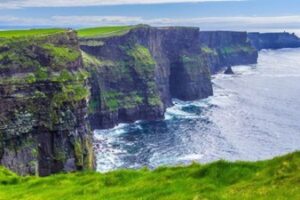
Dr Brian Ua Nualláin (better known as either Flann O’Brien, Myles na gCopaleen, or indeed both) once remarked that Ireland had only known two systems of government: Tanistry and Black-and-Tanistry. Ouch. There is truth in this. You cannot extol England, as I have done elsewhere, without treating justly with John Bull’s Other Island. So here it is. Prehistoric Ireland was inhabited by more than the usual number of curious tribes (Fir Bolg, Fomorians, and the mysteriously exalted Tuatha Dé Danaan, to name but three). The dominant racial strain in modern Ireland are the Milesians. But here is a thing passing strange, demonstrating once again that genetic squiggles aren’t all they’re cracked up to be.
The Milesians apparently took over Éire, and the Tuatha Dé Danaan retreated to their ancient mounds, only to emerge as friends, helpers and eventually gods to the later peoples. If you know your Fenian Cycle, you will recognize that Angus Óg was the persistent friend of Diarmuid Ó Duibhne after he eloped with Fionn mac Cumhaill’s young wife Gráinne. Shades of the Trojan War? Unsurprisingly, for the Milesians came from modern-day Turkey. Genetically, the closest match for the modern Irish are the Berbers of North Africa. And yet. And yet…
They learned to speak Old Irish: as fiendishly complex a tongue as anyone ever devised. Where on earth has it happened that the conquerors learned and adopted the tongue of the conquered? Only in Ireland, doubtless. Rumour has it that possession of the Emerald Isle was decided on the field of Tailteann. Whether this was a battle-field, or a sports contest, we no longer know. Knowing the Irish, it really could have been either. However this may be, we first encounter evidence of Ireland in the Book of the Dun Cow and the Cattle-Raid of Coole (Táin Bó Cuailgne): verily the Irish Iliad. By then, Ireland had turned Christian. And only Christian monks actually wrote things down in books. How had this happened? Why: an escaped Welsh slave named Padraig returned to the lands of his captivity, went from house to house (for there were no cities back then) and expounded the mysteries of the new religion by means of shamrocks and minor conflagrations.
(On the subject of slavery, it is idle to pretend – as some now inexplicably do – that slavery was somehow a tool of European triumphalism. Every culture on Earth has practiced slavery at some point. Some slaves were treated well enough. Ancient Egypt, as ever, was something of an exemplar here. All too many were treated with frightful cruelty. We don’t do this any more. Except that we do. Since the expiry of the Pax Britannica, there are more slaves alive now than ever before.)
Some nations have had their polities seriously damaged by Christian missionaries. Back in the so-called Dark Ages, things were far otherwise. Britain and Scandinavia were improved enormously by the new religion. But Ireland! Conversion wrought a wonder of change in the Emerald Isle. The role of Irish monks in preserving Europe’s heritage was studiously ignored until recently. It took Kenneth Clark (later Lord Clark of Civilization) to tell the world that without sturdy, barefoot Irish monks with their leather bags of immortal manuscripts we would never have known about the Classical world and its Christian underpinnings. If you’d prefer an Irish author, Thomas Cahill has a fine book entitled How the Irish Saved Civilization.
Listen to some of an overly belligerent turn of phrase and you’ll hear that the eternal conflict was between Gael and Gall. Ironically enough, County Donegal (home to Éire’s most celebrated band Clannad) has as its rightful name Dún na nGall: the House of the Strangers. The Galls? Any enemy you care to mention. You will hear the term Sasanach applied a lot. The truth is that the Anglo-Saxons regarded the Irish pretty much the way the English regarded Americans a century ago. Rough diamonds, to be sure, but definitely On Our Side. English nobles sent their sons there to be educated. They knew what the Irish had done for both Christianity and civilization. The Danes? A different kettle of ballgame entirely. The Danes (or Vikings if you must) thought Ireland was wonderful. They looted, pillaged, enslaved, and settled. Most of the ancient towns in Ireland are Danish. Dublin especially. Dublin means Blackwater (Dubh Linnhe), though the modern Irish prefer Baile Átha Cliath (The Castle by the Wooden Ford).
The Danes were – as narrated elsewhere – heroically resisted by the English. The Irish? When you don’t have any towns of your own to fortify, then it all gets way too hard. When you have no orderly succession – as the Irish never did, since anyone claiming descent from Niall of the Nine Hostages could theoretically claim the Throne of Tara – why, Ireland was doomed, surely? The Danes were too strong, too technologically advanced, and too ruthless. Ireland would become part of the Danish Empire. Except that it didn’t. Brian Mac Cennedi (better known to history as Brian Boru) somehow managed to unite the Irish. At Clontarf in 1014 he inflicted a shattering defeat on the Danes. Ireland would henceforth be Irish. Except …. he himself perished in the battle, as did his son Murrough. And it was back to petty kings perennially at war with each other.
Then … the Bloody Normans turned up. Whenever there’s Trooble Up At T’Mill, you’ll always find these tin-hatted fanatics. One of the petty kings asked for English help in one of his interminable squabbles. Give the Normans an inch, and they’ll take a mile. Suddenly Ireland belonged to England. King John – last and most thoroughly worthless son of Henry II – became their monarch. He took it into his head to have a Frat Boys’ Tour in which he insulted practically everyone. One of his party who could actually read and write was Giraldus Cambrensis. He wrote the following about the natives:
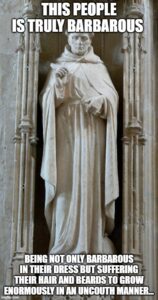
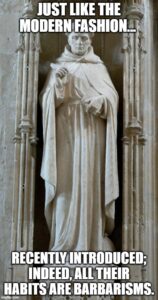
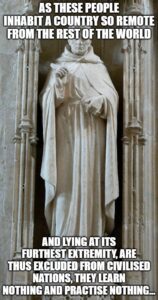
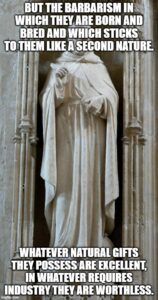
Back then there was no social media to contest this. And in future centuries, that was what Everyone Knew about the Irish. Without it, Edmund Spenser’s Faerie Queen would have been impossible. Spenser was a gifted poet. It’s a pity he wasted his talents on such a farrago of nonsense. Queen Elizabeth had a great many plastic flowers flung at Her royal feet. Some were genuine works of art, like Edward Johnson’s madrigal contribution to The Triumphs of Gloriana. And some, like Spenser’s fetid contraption, were frankly awful. And yet everyone who didn’t know Ireland believed it.
The Normans, as was their wont, built castles and stole anything that wasn’t nailed down. Except …. most of the Norman incomers went native. They found Ireland’s culture more agreeable than their own, and became indistinguishable from the homegrown chiefs. This wouldn’t do for the English at all. Which was the origin of The Pale: a narrow coastal strip between Dublin and Cork in which a Little England in exile was supposed to flourish. Or something. But things did not go seriously wrong until the Tudors. That abysmal tyrant Henry VII had no time for anyone who dared flout his merest whim. So he gave the Irish a Parliament, but under Poyning’s Law the English were to pass all the Acts in it. Under Elizabeth matters deteriorated. And it really shouldn’t have been like that. Gloriana was poorly advised. She only found out that She’d been hoodwinked very late in Her reign, when Grace O’Malley (aka Gráinne Ní Mháille/Granuaile) met the Queen to protest her ill-treatment at the hands of the then Lord Lieutenant.
Gráinne’s nerve was tested by being made to wait a fortnight for an audience. Finally she was admitted. An Irish translator had been provided; but the Pirate Queen of Country Mayo swept him aside, announcing that she would speak with the Queen’s Majesty in Latin. She claimed to be a wronged widow done out of her rights of inheritance. Both knew that this was largely nonsense; but that was not what interested Gloriana. For once in Her life, She realized that She had met Her soul sister: a woman as mighty, imperious, strong-willed and intelligent as Herself. Gráinne wept some well-versed tears, and a lady-in-waiting offered a silk handkerchief. On being used, it was flung into the fire. The Lady was shocked. Gráinne looked at the Queen in surprise.
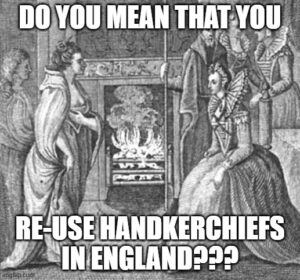
The Queen had heard enough. The Lord Lieutenant’s orders regarding Gráinne were countermanded, and she returned home in triumph. Here’s a piece of alt-history which tells how it ought to have gone. It has wizards, bards, and Gráinne in it, and if you’re Irish you may find it consolatory:
After the heady days of medieval conquest and dynastic struggle, what England wanted above all else was that their Western neighbour should not and must not have an independent foreign policy. Allow me to relate the tale of the decisive battle of Kinsale in 1603. The effete Earl of Essex had been sent by the Queen to deal with the latest Irish rebellion. Essex was a deeply impressionable young man, and no match in wits for the glib and persuasive O’Neill, Earl of Tyrone. Elizabeth recalled Essex, removed his head (it wasn’t a terribly good head anyway) and replaced him with Lord Mountjoy. The Spanish army represented all the horrors of the Inquisition. Were they allowed to take root, England as we knew it was finished. The very best we could have hoped for was a long and bloody attritional war, fought on land against inexhaustible numbers of Europe’s best infantry. For Mountjoy it was nothing less than a battle for national survival.
He faced not only the Spanish – whom he penned up in Kinsale with commendable alacrity and precision – but two Irish armies led by O’Donnell and O’Neill, who could not however agree on a unified command. As the French repeatedly discovered during the Hundred Years’ War, Command and Control is essential on the battlefield. Historians suggest that O’Neill – who favoured harrying the English rather than pitched battle – was probably right. English casualties were severe: more so than the Irish. Had it not been for the British navy (which repelled Spanish reinforcements) it really could have ended in defeat and disaster. The entire British Isles might have become Spanish provinces. This deliverance we all owe to Mountjoy.
For the Irish it was however the beginning of the end, and the dawn of the age of the Wild Geese. Young men saw no hope in their homeland, and took service abroad with foreign masters. Now here is another of history’s turning points. In 1604 the Spanish began to make terms with England. James I wanted peace with Spain, and thanks to Mountjoy’s victory it became possible. The grandees of Spain found in the redoubtable English much to admire so long as one overlooked that they were godless heretics. The feeling was mutual. If the Spanish, it was held, could get over their incorrigible zeal to burn heretics at the stake then there was much to admire in these medieval lords. Peace was secured. The idea that England vs Ireland was a religious war had plenty to commend it. Yet the Pope was lukewarm. He did not wish to antagonize the French, who viewed Spanish expansionism with well-merited alarm. A diplomatic solution to The Irish Question was now theoretically possible.
I have mentioned elsewhere that Charles I – that diligent, conscientious and inexpressibly delusional monarch – cherished the Irish enough to send Wentworth, his most able and honest deputy, to rule over them in the 1630s. The Irish who fought in the Civil War were not delusional. They were some of Charles’ best troops. Alasdair Colkitto’s Antrim division was the mainstay of Montrose’s astonishing feats of arms in Scotland. They fought for King Charles because they knew exactly how much the Puritans hated them and wanted them all to die. When the Puritans demanded Wentworth’s head, and got it in 1641, Ireland rose in bloody revolt. How widespread were the massacres on either side we will never know. What we do know is that Protestant Europe was outraged. The body count of innocent civilians slain by the heathen Irish grew in the telling. Ten thousand! Do I hear twenty? Thirty? What about fifty thousand? Hell, why stop there? It cannot be denied that the innocent were indeed massacred. What matters is why the Irish did it. Wentworth gave us even-handed justice. He made English rule in Ireland tolerable. Who even knew? But obviously this is a crime and Wentworth must be slain for it. Well, we know what’s coming next. Let’s get in first.
Oliver Cromwell is still remembered with loathing in Ireland. As well he may be. In his heart he was a Puritan from the previous century. He had not the slightest understanding of his western neighbour. He was largely merciful to his defeated enemies elsewhere; but to the Irish he gave nothing but fire and the sword. The wholesale depopulations of his regime were carried out by Fleetwood his deputy, yet he must bear the blame. Charles II by contrast left Ireland alone. He had bigger problems, like trying to wean his subjects off their anti-Catholic prejudices. But when his idiot brother James II was kicked off his throne, he ran away and attempted to regain his crown with Irish help. Here was a heaven-sent opportunity for the Irish to tell him to go away and annoy somebody else.
Alas, this was not to be. The lunatic logic of the Puritans had rendered their worst nightmare manifest. He’s a Catholic king? Very well. Let’s fight for him. Had the Irish in 1690 pondered European events more thoroughly, they would have reasoned thus: The enemy of Europe is Louis XIV, who made a Devil’s bargain with the Sultan to divide Europe between them, and encouraged the Turks to besiege Vienna. Innocent XI – one of the best Popes in history – urged the Poles to fight. The victory of Jan Sobięski’s cavalry ended Ottoman expansionism in Europe. This same Pope was an Odescalchi: a prominent family of bankers.
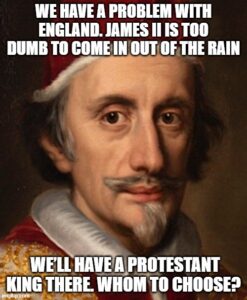
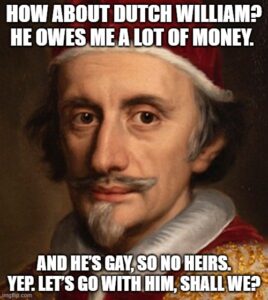
How we all wish that the Irish had paid attention. Instead we got the Battles of the Boyne and Aughrim. More Irish warriors slaughtered in a depressingly unworthy cause. More Wild Geese, more dispossession, more tragedy. During the eighteenth century the rebellions continued. Really: what else could the English expect? Precious few Lords Lieutenant troubled themselves to attempt to follow Wentworth’s example of mercy, forbearance, and even-handed justice. One who did was Lord Cornwallis: he who lost the American colonies. Many a convicted Fenian was offered mercy if he would join the Connaught Rangers, who fought with conspicuous gallantry in the Peninsula Wars. Wellington was grateful. It was also Wellington who repealed the pernicious Penal Laws disabling Catholics from their rights:
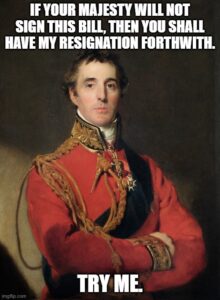
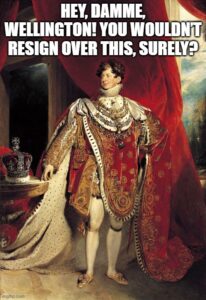
As ever, the Tories attempted to heal. The Whigs wouldn’t have a bar of it. When the potato crops failed – again – the Irish starved. When this happened in the 1790s food poured into Ireland. Because we cannot sacrifice humans to economic theory. Under the Whigs in the 1840s the Corn Laws remained in force, and the result was known as the Gorta Mór: the Great Hunger. A million Irish perished miserably, and another million emigrated in coffin ships. Finally Sir Robert Peel – the same Tory stateman who had persuaded Wellington to repeal the Penal Laws – managed to get the Corn Laws quashed, and the Irish were given belated succour. Peel was under no illusions as to what this entailed for him. His government fell, and he narrowly escaped assassination by an enraged profiteer. So far as he was concerned it was worth it. (By the by, many Protestant landlords freely remitted all rents during the Famine, and their tenants survived. Many went bankrupt doing so. Including one of my ancestors, apparently.)
The ineffable Gladstone made a great deal of noise during his sixty-two years in the House of Commons. He clamoured for Home Rule, when he wasn’t addressing the Queen as though She were a public meeting. As usual with Gladstone, his vapourings came to nothing. During WW1 matters came to a head. The loyal Irish who trusted England to deal justly with them were swindled out of their hopes. And at Easter in 1916 (according to the poet Yeats) a terrible beauty was born. This writer begs to differ. Occupying a municipal post office really doesn’t cut it. Had the English had the elementary common sense to pardon the rebels it might all have died away. Where Ireland is concerned, England has too rarely chosen that path.
But change was coming, not least because of the Orangemen. They were planted in Ulster by James I: ostensibly to populate his rebellious provinces with loyal subjects. Actually, one rather suspects that he sent them there because they were an intolerable nuisance. The Orangemen were the spiritual – and sometimes literal – descendants of the Covenanters: quarrelsome, fanatical sectaries ready to pick a fight with anybody. The loyalty of the Orangemen to the Crown, it became apparent, was conditional only. Some spoke openly of allying with Protestant Germany. And David Lloyd-George – a mercurial Welshman with far-sighted ambitions – decided that enough was enough. No, we cannot give them all their country back. The Orangemen will never wear that. How about 26 of the 32 counties? Would that be acceptable?
It was for Michael Collins, an IRA leader. One of the English signatories to the pact which established the Free State joked that he was signing his political death-warrant. Really? Collins memorably remarked. I’m signing my actual death warrant. In due course Collins was indeed assassinated. According to the irreconcilables of the IRA, he should have held out for all or nothing. And it would of course have been nothing. We believe he went to his death willingly. Most of Ireland will be free. This is worth dying for.
The Irish Free State was a strange concoction ruled over by the Fine Gael Party. The Protestants in the south were ethnically cleansed. At least it wasn’t 1641 this time. The Free State might have gone the way of the Weimar Republic save for the intervention of one of modern history’s most extraordinary characters. Eamonn de Valera led the Sinn Féin opposition who refused to take their seats in the Dáil. The sticking point was the Oath of Allegiance, which he and his colleagues refused to take. He founded a new party, the Fianna Fáil (Soldiers of Destiny!) which became the government in 1932. He then waged economic war on Britain, united the country behind him, and in 1937 established the Republic of Ireland. Leaving aside his complicity in Collins’ murder (which is a matter of obscurity) there cannot be any doubt that de Valera was a politician of genius. An evil genius? He resembled Francisco Franco; yet his intellect was far greater. He did manage to unite his fledgling nation, and that was a serious achievement somewhat against the odds.
At the outbreak of World War 2, the British were seriously alarmed by the prospect of neutral Irish ports in which Nazi warships might theoretically land and spell doom for Britain’s heroic resistance. It was known that the IRA had already sold themselves to Hitler lock, stock and barrel. As a result, German spies were parachuted into Ireland to infiltrate behind the wall of British sea-power. We do not know if the Abwehr was serious about this, but Hitler certainly was. He believed the assurances of the IRA leadership that Ireland was ready to succumb to the Nazi juggernaut.
We may allow ourselves a retrospective smile at the idea of Germans trying to pass themselves off as native Irish. All were rounded up by the Gardaí and the secret police within 24 hours. As a gesture of goodwill, de Valera handed over their files to the British to run them as ghost agents feeding disinformation to the Abwehr. And he allowed British warships harbour in Irish ports. Once Churchill realized what the Long Feller was up to, he shut up about Ireland for the rest of the war. Like Franco, de Valera cheated the hopes of the Nazis. It was indeed the most benevolent of neutralities. And it got better. The treason of the IRA was more than redressed by the multitudes of Irish who joined up for the cause of freedom. Heading the list was Brendan Finucane, the famous RAF fighter ace (The Shamrock Spitfire). His unfortunate death at 21 was mourned across the Empire.
After the war everything went quiet in Ireland. De Valera was – like Franco – a staunch Catholic and refused to allow matters of modernity in his little realm. The Orangemen continued to oppress and bully the Catholic minority in the Six Counties. Yet all might have turned out well, had not the Royal Ulster Constabulary taken it into their heads to suppress Bernadette Devlin’s civil rights marches. It is difficult to know what to make of the RUC’s insane decision to open fire on Bloody Sunday. Until that moment the IRA was regarded with contempt by most of the Irish population. The IRA and Sinn Féin alike had experienced no support to speak of in Ireland proper for many years now. But after that there was nothing for it, apparently, but war to the knife.
Dreary, blood-spattered decades on the Murder Mile and elsewhere followed. The IRA made themselves the most hated terrorists in the English-speaking world, all except for their Boston-based enablers across the seas. It took Bono, of all people, to make a stand against The Cause. People sneer at rock stars and their designer consciences. To denounce the IRA on a public stage as Bono did takes raw courage little seen in these degenerate times. Whatever public support the IRA might have retained was blown away by Dolores O’Riordan’s song Zombie. Meanwhile every terrorist outrage stiffened British determination to stand firm. They could do no other.
And then there was Tony Blair. A much-reviled figure now, thanks to the Iraq fiasco and many other matters. And yet…. had you mentioned to anybody during the latter stages of last century that a British PM could succeed in getting Gerry Adams and Ian Paisley into the same room, they would have laughed in your face. Incredibly, Blair did just that, and secured a peace agreement. Which still, more or less, holds firm. The future is unknown, as is that of the Six Counties. To Sinn Féin, all we can say is: Tiocfaidh Ár Lá? Be careful what you wish for….
Where now for Ireland? The collapse of the Catholic Church as moral arbiter has changed things irrevocably. Irishness became inseparable from Catholicism centuries ago. It shouldn’t have been like that; but the myopic cruelty of the Protestant Ascendancy drove the downtrodden into the militant arms of the priests. De Valera encouraged this sentiment, which turned out to be his only error of judgement. When the manifold sins of the clergy were unmasked, the mood in Ireland turned ugly. Irish folk have many virtues. Forgiveness isn’t one of the more obvious ones. Magdalen laundries, mass graves, formation misogyny and scandalous cover-ups have destroyed the theocracy. And a good thing too. Theocracy is almost always terrible. Ireland is currently enjoying the general euphoria which always comes with relaxation of so-called morality. History teaches us that this doesn’t last. What comes afterwards is anyone’s guess.
That, in brief, is the history of Britain’s western neighbour: John Bull’s Other Island in truth. Many have lamented the fact that the British have short memories, and the Irish long ones. Would that it had been the other way around!
Long ago, when the world wasn’t as much out of whack as it is today, I was invited to launch a book. I’ve launched a lot of books, in varying degrees of bizarreness. This one was well up there with the best of them. It was A Celtic Childhood, the author Bill Watkins, and the venue Melbourne’s Celtic Club. Which was at the time about as rabidly Fenian an establishment as you could find in these parts. I was apprehensive, since the author (a polymathic Scot) was possibly unaware that the Celtic Club was heavily pro-Irish, and not terribly keen on anyone else laying claim to Celticism. Least of all the Scots, who were inherently suspect in the eyes of the implacable Australo-Irish of that establishment. And there was Bill, complete with Highland kilt, wondering what I was going to say on his behalf. But there it was. I was the deputy guest of honour, and had been asked to front up with robes, staff and pointy hat.
And so up the stairs we trooped, and I was introduced by the Hon. Secretary in tones of deep suspicion. He wasn’t sure what His Excellency Archbishop Mannix would have made of an actual wizard in his adoptive premises; but here he is and would you all kindly welcome him? I thanked him in my best Irish (not very good, but adequate to the occasion), explained that I had paid my respects on the stairs to the statue of Milord Mannix; and I set to work on my speech. When I said my piece about There’s been nothing like it since George Borrow I got a mighty roar of approval from Mr Watkins himself. ‘Got it in one!’
It’s pleasant to know you have divined an author’s intentions. So I wound my way towards my big payoff, which included a recitation from his book in Scots Gaelic (that’s Gàidhlig to us), and with my concluding jest I realized I had won over my sceptical audience. Now it is known that we wizards do wave the Union Flag a fair bit. If you are going to march into enemy territory, do show a bit of cultural sensitivity. I began to learn Irish under the influence of Clannad’s early albums, which had barely a word of English on their record covers. I gave up at the rules of eclipsis, which did my head in. Lenition (or aspiration if you prefer) I can cope with. Eclipsis in genitive plurals I can do. But… the nominative plural of bean = woman is mná. Which looks like eclipsis, but the Wise and Learned have informed me it actually isn’t; but comes from a different word in Old Irish: a frankly terrifying language and pretty much impenetrable to all but the mightiest of scholars.
If one is going to be the representative (willing or no) of a regime which not only conquered their ancestors but treated them with quite uncharacteristic cruelty, then be on your best behaviour. No Tories nowadays would even pretend that the regime of Dublin Castle was anything but a monstrous blight upon our empire. What I was doing was extending the hand of friendship to ancient enemies. It appears to have been accepted. Tabhair dom do Lámh! And may we never come to blows again.
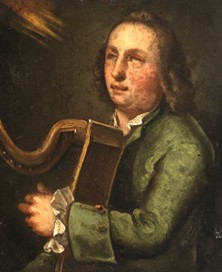
(Toirdhealbhach Ó Cearbhalláin, the famous 18thC harper. His life is a signal lesson in how a subject people can gain moral superiority over their masters. My Irish quote just previous is the title of one of his impromptu songs. I can think of no better sign-off.)