There is a hole in the heart of the English-speaking world. And it stands in desperate need of some therapy. In 2025 a 12-year-old English girl was punished for daring to wear a Union Jack dress to school for their dress-up day. Students were told to embrace cultural diversity. She did. This wasn’t acceptable to her teachers. Apparently they wanted to give Nigel Farage and his Grumpy Party yet another PR sugar-hit. Then again, perhaps they’re just stupid.
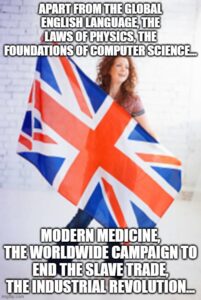

(And no, this isn’t the girl in question. After the initial media circus she may want some privacy.)
Of late, there has been a curiously persistent fantasy abroad to the effect that all the evils that afflict our planet are the fault of Britain. If only we could expunge British influence from the world at large, then we could all dance in circles and live happily ever after. Now if that really is your preferred flavour of Kool-Aid, then obviously nothing I say will have the slightest impact on you; and you may as well log out now. For those who still cling to the absurd belief that facts and history actually matter, then please do read on. And remember this, as ever. The fact that you are reading this at all, in the tongue of an obscure Germanic tribe in the Dark Ages, suggests that there might be something in this whole English business after all.
England’s rich farmlands and comparatively mild climate made frequent conquest inevitable. Pre-history saw waves of invaders. First the q-Celts (Bronze Age), then the p-Celts (Iron Age), then the Romans, and finally the Teutons. That waves of German holiday-makers attacked and conquered Romano-British territories was a tragedy all of its own. The enduring miracle was that it took them a couple of centuries to complete the job. And that despite the incurable petty rivalries of the British chieftains, as narrated by St Gildas the Wise. I will largely omit King Arthur, as being far too large a topic for this brief history. Yes, there almost certainly was a Romano-British chieftain who united the tribes and fought back.
Ambrosius/Artos/Rigotamus must have existed. How else to explain the curious fact that in the Anglo-Saxon Chronicle (the journal of the victors) the tide of conquest moves steadily westward and reaches Hampshire in the 470s? Then there is an eighty-year pause until the 550s, when they’re suddenly conquering Hampshire again. What killed off Arthurian Britain was the Justinian plague of the 540s, carried by Roman traders everywhere they sailed. The fetid medieval nonsense about the Waste Land has its origin in fields lying idle because none were left alive to tend them. The Germanic tribes suffered less from the pestilence, and found themselves able to push the Britons back into Wales and Cornwall. After the battle of Deorham in 577 England proper was born.
With the coming of Christianity these flaxen-haired savages underwent a miraculous change. The little war-bands slowly consolidated into seven kingdoms, which eventually became three: Northumbria, Mercia and Wessex. Peace and plenty – by and large – became common. But in the late 8th century another calamity occurred. We can thank Charlemagne for that. In his monomaniacal campaign to spread Christianity by fire and sword, he destroyed the sea-power of the Frisians. Further north, the Scandinavians – hitherto hemmed in to their icy fjords – suddenly discovered they were free to sail their longships anywhere they pleased. And they did. The coming of the Danes provoked an unbelievable response. Consider this. The Danes looted and pillaged all over the Known World. Nothing could stand against them. Tolkien’s colleague EV Gordon wrote:
Nowhere in Christendom did the fury of the viking attack fall more heavily than on England, and nowhere was fiercer resistance encountered than in the little kingdom of Wessex.
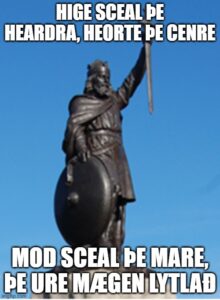
These words actually come from much later, from the late 10thC poem Battle of Maldon. I would translate this as follows: Mind must be sharper/ heart the keener/ spirit burn the brighter/ as our strength lessens. Byrhtnoth, ruler of Essex, was faced with a Danish invasion from East Anglia. This fearsome warrior (he was over two metres tall) was challenged by the Danes to let them cross the river so they could have a fair fight. Over-eager for glory, the idiotic duke allowed it. He and his hearth-companions were all killed. Because they fought on to the last man, the Danes suffered so many casualties themselves that they returned home. It had been a truly Pyrrhic victory. Maldon is a superb poem. The beginning and end are now lost. The fragment we have begins with the direful words brocen wurde. (= would be broken) Byrhtnoth’s bones lie in Bishop West’s chapel in Ely cathedral, next to Archbishop Wulfstan of York (qv, author of Sermo Lupi ad Anglos and much else). If you don’t know Latin you may not even know they were there. I once gave a short harangue on this to the vergers there before reminding myself that I was a guest in their church and should probably shut up now. So I did, and departed.
The steadfast courage of the men of Wessex gradually spread over the English lands. The Battle of Ashdown in 871 – Alfred’s first victory – showed them that the brutal invaders were not invincible. Alfred fought nine battles that year. At one point he was obliged to hide in the marshes at Athelney because his capital was overrun in a surprise attack. But he never gave up. And seven years later he inflicted a shattering defeat on Guthrum’s huge army at Eddington. The aftermath was just as decisive as the battle itself. Alfred knew that promises from pagans meant nothing to them. They broke their word as soon as it was convenient. Penned up and starving, Guthrum begged for the lives of himself and his men. Alfred agreed provided they converted to Christianity. Guthrum agreed on the provision that Alfred himself would be his baptismal sponsor. Alfred realised at once that while Guthrum was an astute bargainer and wanted a face-saver before his men, it would be very much in both their interests to agree. So he did.
The Treaty of Wedmore was a wise and far-sighted strategic victory. Alfred ceded the Danelaw to Guthrum – he didn’t have it anyway – and in return Guthrum accepted Alfred’s regime in Wessex. Uniquely for the time, the agreement was kept by both sides during their lifetimes. Guthrum remained half-pagan – he could not have ruled his pagan subjects in the Danelaw otherwise – but returned home. Meanwhile Alfred used the Church to rule his kingdom. As he wrote afterwards, nobody else could read and write; and even among the clergy there were very few who knew any Latin. Alfred translated Gregory the Great’s Pastoralis into English for the benefit of his clergy, and began the immense task of producing a literate society.
Alfred was the fourth son of his father. His three elder brothers and his father all perished in battle with the Danes. He suffered from asthma and died at 50. When he ascended to the throne you could have got ten to one against him seeing out the New Year. Yet he ruled for thirty glorious years. Unlike Charlemagne, the seeds he planted bore astonishing fruit. His descendants gradually took over all of England. Most notable of them all was his daughter Æðelflæd, the warrior queen of Mercia:
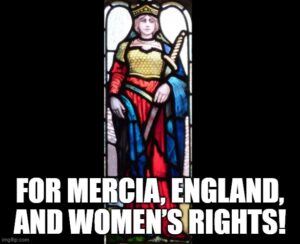
She and her husband Æðelræd fortified and secured West Mercia (beyond the Danelaw boundary at Watling Street), and after his death she reigned in her own right. She had Judith (the companion poem to Beowulf) dedicated to her. The English didn’t share weird Norman ideas about women. In fact English (and Icelandic) women had far more rights than in Continental Europe. Justice was even-handed, impartial, and enforced by ealdormen and the local hundreds. Groups of ten were all responsible for each other’s behaviour. It was a trust-based society. Perhaps they were too unimaginative to lie. If you saw a crime being committed, you were expected to raise the hue-and-cry. Everyone who heard it must join in to apprehend the perpetrator. By the standards of the day, legal punishments were moderate enough. They preferred mutilation to execution, and fines to mutilation. Wergild was paid either to the victim (if alive) or their relatives (if deceased) and the tariff was set by the king. Typical examples being 12 shillings for a broken thigh, and 50 for loss of an eye. Most court cases were settled with fines.
If a woman’s honour was outraged the penalty was death by hanging, with several more merciful options. Would you like to marry the man? No? Didn’t think so. Would you accept a fine? Oh, you would. By the way, the money’s yours. Not your father’s, nor your brothers’. Crazy Norman ideas of treating women as property were unthinkable in Anglo-Saxon England. It was a beacon of sanity and civilisation.
Alfred’s descendants united all England. Unfortunately England was afflicted by twin calamities. During the 10thC the Church became too powerful. And alien ideas from the Continent began to creep into England. The other disaster was the reign of another Æðelræd. He is remembered as Ethelred the Unready. It was actually a grim jest. His name means Noble Counsel. His nickname Unræd mean Bad Counsel. Delighted to discover a total pillock on the English throne, the Danes began to invade again. He bought them off, they sailed away, and came back next year for more. Like many a weak and stupid ruler before and since, he then decided on a bout of ethnic cleansing. The St Brice’s Day massacre of 1003 was the result. Sveinn Forkbeard of Denmark and his son Knut the Great heard about it, and disapproved.
The Danish conquest of England in 1016 was surprisingly peaceful. The English had had enough of their dismal monarch anyway, and young Knut turned out to be a model Christian king. Some of his proclamations and laws were drafted by Wulfstan, Archbishop of York. You might expect a prelate from a conquered people to keep a low profile, but Wulfstan wasn’t having any of that.
The line of Knut quickly died out in England. Which was a great pity because the next king of England was the calamitous Edward the Confessor. He’s been canonised, for no readily apparent reason. He gave away land and treasures he could ill afford to the power-hungry Church, Inc. But his worst deed was promising the throne of England to William the Bastard, in return for being rescued from shipwreck. The throne wasn’t his to offer. Succession was decided by the Council, or Witenagemot (= meeting of the Wise). Had he been even notionally English he would have realised that. He was the seventh son of the equally disastrous Æðelræd. During his reign the Godwinssons – a powerful English family – took effective control of the realm. One sees their point. On Edward’s death the Witenagemot put their heads together and awarded Harold Godwinsson the throne. To do justice to the loathsome William, in his Frenchified view Edward’s promise was a binding oath. And Normans took oaths seriously.
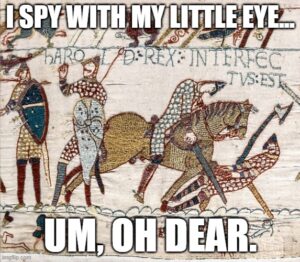
I am personally traumatised by the Norman Conquest. Yes, it was a long time ago. But the wounds are still raw. Consider the facts. Anglo-Saxon England was the pinnacle of Christian civilisation at the time. The tin-hatted savages who conquered them were unbelievably lucky. King Harold Godwinsson had already wiped the floor with a Danish army twice the size of his own at Stamford Bridge. The invaders were led by Harald the Ruthless, last of the Viking buccaneers who terrorised the Known World during the so-called Dark Ages. Sensing that his moment had come, William the Bastard of Normandy attacked, late in the year, with an army of land-hungry brigands. Norman arms and armour were the terror of the age. Yet Harold’s exhausted men held the shield-wall until the Normans pretended to flee. Instead of staying where they were, the English broke ranks. From then the battle turned, and the final catastrophe followed.
I have walked the Via Dolorosa at Battle. It is a grim business. When you reach the café/souvenir shop, there is a large sign on the wall, with a quote from Sellar & Yeatman’s 1066 And All That. It reads:
The Norman Conquest was a Good Thing, as from this time onward England stopped being conquered and thus was able to become top nation.
I managed a rueful smile. I will pass lightly over the hideous consequences of Norman rule. Like many a conqueror before and since, William was harsh and ruthless. To safeguard the North of England he made it into a desert, destroying crops and carrying off everything of value. Tens of thousands perished miserably. Freemen all over England were enslaved. Yet amid the horrors of the Conquest something strange happened. The Normans began by treating their English subjects the same as the French, with brutal contempt and indifference to suffering. But England was more fortunate in their kings. They realised that the English were diligent, law-abiding, and paid their taxes. When they began mumbling in their beards about unriht, it was worth your while to listen.
Thus Henry II, one of the best kings in recorded history. He gave us the Common Law. The feudal system was a vile construction of organised slavery. No sooner was it established in England than the kings began to undermine it. Henry Beauclerk (Henry I) began the process by establishing borough towns. If you were a serf with skills in demand, and could find a craftsman to make you his prentice, if you remained hidden for a year and a day then you were legally free. The following conversation would have been a familiar tale:
Commerce thrived. Free people are more productive than serfs. The Normans also believed that barons and lords should try cases in their own jurisdictions, and set their own punishments. Edward Longshanks sabotaged this effectively by creating the Court of the King’s Bench. Yes, you may choose to be tried by your overlord if you like. Or you can appeal to the King and be tried in my courts. Before too long, manorial courts quietly died out. And good riddance.
(The other crucial advance made by the Normans in England – primogeniture – is rarely spoken about today. My fifth-grade history teacher made a big point of it, and she was entirely correct. In Britain only the eldest son inherits a title. The rest have to shift for themselves. What this means in effect is that the ruling class cares about commoners; because members of their own families – up to and including duchesses – are commoners themselves. Continental European aristocrats doomed themselves to extinction by isolating themselves from the peasantry. If all descendants of nobility are themselves noble, the class of useless parasites expands until the economy collapses. Chroniclers record villages where every single inhabitant claimed noble blood, and were thereby excused from work. Unsurprisingly, they did not survive.)
The English tongue lived on, even though Norman-French was the official language of law and government. Having studied Early Middle English, I have to say that it is quite an effort to read. The grammar isn’t hard. Old English (or Anglo-Saxon) was an inflected language rather like German. Seven classes of strong verbs, three classes of weak verbs, two tenses, three genders, four cases – if you know German you will find Old English awfully familiar. (Just remember that the consonants are softer than in German). After the Conquest Middle English largely lost its inflections and relied much more on word order. The difficulty with the texts we have is that they are awfully dull. I would rather eat raw broccoli and silverbeet than wade through Sawles Warde again. But in the middle of the calamitous fourteenth century something wonderful happened. Piers Plowman, Chaucer, the Gawain-poet: out of nowhere arose some of the best poetry of the Middle Ages. In the cosmopolitan south-east rhyme was king. Since the poetic big league was in France, it’s hardly surprising that Chaucer and co. chose it. Further north, poets decided to revive Old English alliteration rather than using rhyme. Although Pearl and Sir Gawain and the Green Knight have rhyme as well. Stanzaic alliterative poetry (those two, plus Somer Soneday) ought to have been the wonder of the age. The only problem is that West Midlands Middle English is much harder to understand without training. Compare the first couplets of Canterbury Tales and Gawain:
Whan that Aprille with his shoures soote/ The droghte of March hath perced to the roote
Siþen þe sege & þe assaut watƷ sesed at Troye/ Þe borƷ brittened & brent to brondeƷ & askeƷ
Chaucerian English is a lot easier for modern readers. Although there are many lurking pitfalls, since a lot of the words don’t mean what you think they mean. Even at the time, Londoners would have struggled to understand West Midlands dialect. (By the way, the yogh character Ʒ is used for many different sounds, notably the participial prefix -ge, and also a final s. Go figure.)
Where did this luxuriant poetic growth come from? We really don’t know. With the Known World devastated by the Black Death, the last thing anyone might have expected was a sudden flowering of poesy. Yet it happened. The question of how English took over as the dominant language in England is easier to explain. Edward III had decided that he was the rightful King of France (which he arguably was) and embarked on an ultimately futile attempt to conquer it. He won decisive victories at Crécy and Poitiers. But the only way castles could be taken without reliable cannons was through ravaging the countryside and starving them out. This is not going to win you any popularity contests. On the Continent, Englishman was a name of dread and terror. After the Treaty of Brétigny in 1360 Edward renounced his claim in exchange for extensive territories in France. The crucial point here was that the Norman freebooters had to make up their minds whether they would be English or French. For the men who decided to hold only their English lands, this meant that they stopped being absentee landlords and learned to be English. Which was a good thing indeed.
Modern English is not an easy tongue to learn if you aren’t born to it. Yet it is for the most part the tongue of freedom, largely because of its immense vocabulary.
Between four and five thousand modern English words are Anglo-Saxon. ‘The quick brown fox jumps over the lazy dog’ is purely Germanic. The Danish/Viking invasions brought many new words into English, like egg, window, leg, skull, sky, and steak. Also (inevitably) the word ‘take’, (from the Old Norse táka). Perhaps surprisingly, also the word ‘law’. ‘Shirt’ and ‘skirt’ used to be the same word. But the Old English scyrte moved upward, while the Norse skyrte headed downward. After the Norman Conquest, two waves of French words were imported wholesale. 12thC Norman-French gave us duke, general, soldier, army, palace, merchant, mutton, beef, pork, cattle and (inevitably) castle. It also gave us lots of words like wage, warranty and the like. 14thC French words replaced the c’s and w’s with ch and g, so we got chattel, gage, gauge, guarantee and so forth. A warranty is not the same as a guarantee. English has a unique capacity for delicate shades of meaning.
Since Latin was the language of scholarship all over Europe, it was inevitable that it would barge into English and throw its weight around. Around half of our word-hoard comes from Latin. And we haven’t stopped ever since. We’ll take words from anywhere, and we continue to this very day. English is not merely the tongue of conquest. Non-English speakers are always borrowing our words. Because English is the most flexible and adaptable of tongues. Do try to speak it – and write it – properly. Once upon a time students could go to university and learn English from its earliest beginnings up until the present day. I did so, and have never regretted it. Yet the proper study of English has all but vanished from the modern campus. May we have it back, please?
Footnote: I am very weary of hearing nonsense about the British Empire. I have set the record straight here:
Nor have I forgotten our subject peoples closer to home. What about Ireland? you may protest. Verily. Here it is:
While we’re on a roll here:
and here:
Britain contains multitudes. And since we have been conquered ourselves a fair bit, this adds a breadth of sympathy towards others in a similar plight. The British are quite serious about self-determination. Once were empire-builders? Yes, we were. Not any more. But the solutions we found to seemingly intractable problems really do work. Do try them out.