WB Yeats, sometime poet and member of the Seanad Éireann, made this prescient lament in 1919. He foresaw a time (between the two World Wars) all too much like our own. Moderation has failed! It is time for extremism! When he wasn’t moaning about his unrequited love for Maud Gonne, Yeats was a decent prophet on his own terms. His rough beast could have been Hitler, Stalin or both. These are hard times, and extreme measures are required! We need a Strong Man to lead us to safety! And so on, and on, and on. And yet… the evidence does suggest otherwise. Moderation is out of fashion now. This is because as a civilisation we have lost our marbles. Yet sensible moderation works in a way that extremism doesn’t. Part of the problem is that for unfathomable reasons far too many people still behave as though the terms Left and Right still mean something. Nobody should care in these latter times who sat where in the 1789 National Assembly. This is where the terms Left and Right originated.
French philosophy being in the highest degree suspect, this should have been an awful warning not to become embroiled in a failed epistemology. And the National Assembly led inevitably to the French Revolution, which (unlike the Glorious Revolution of 1688, and the American Revolution of 1776) was characterised by anything other than moderation. Edmund Burke foresaw quite early on that the French had not reformed their polity. They had destroyed it. Little by little, all the English intelligentsia save Byron realised that he was right. The French had sown dragons’ teeth, and we got Napoleon Buonaparte and a twenty-two year war which laid much of Europe in ruins. Countless millions perished from war, disease and starvation.
Largely because peace with Napoleon was impossible. Like Hitler, he needed to keep on conquering in order for his empire to survive. Unlike Hitler, he was a polymathic genius. Yet vanity, cruelty, duplicity and self-deception eventually undid him. The forces of Counter-Revolution were eventually victorious. It could have been a peaceful evolution to modernity from there. But at the Congress of Vienna there was a fateful meeting between two of the victorious envoys, Lord Castlereagh and Prince Metternich. The former was a socially awkward introvert; the latter a glittering extrovert with the world at his feet.
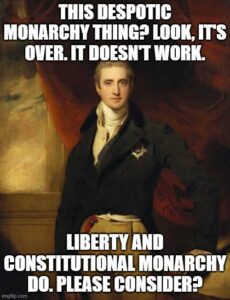
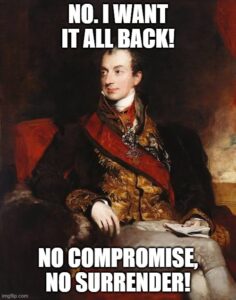
Austria-Hungary limped on until the First World War, but Metternich’s refusal to listen to Castlereagh doomed his empire. Moderation works; extremism doesn’t. But Left and Right don’t work as a credible description. Those who think in clichés would have it that both these men are right-wingers. But this is hardly a helpful depiction.
Let us instead borrow some terms from higher maths to examine the problem. The brighter ones amongst you will know that political views exist in an n-dimensional space. In order to attempt navigation, we select what we hope is an orthogonal basis (it probably isn’t, but whatever) and start to name the axes. (Sorry: I’m talking dirty here. But linear algebra really is a thing.) Here’s how it looks:
x axis: progressive vs conservative
y axis: libertarian vs authoritarian
z axis: materialist vs spiritualist
w axis: individualist vs collectivist
φ axis: reason vs emotion
ψ axis: realist vs fabulist
χ axis: tribal vs contrarian
There are doubtless more dimensions to our problem. And now you see the scale of our dilemma. Non-mathematicians find even three dimensions hard to envisage. Any more and their minds go into meltdown. But here’s the rub: x, y and z used to be a reasonable 3D picture of most people’s politics. The latter three have become far more important. And this isn’t a good thing. While progressivism has to a fair extent lost its way, the sad truth is that what is now called conservatism is a global laughing-stock among the intelligentsia. Largely because these people think tribally, and have not the faintest conception of where they stand in the n-dimensional space mentioned above. Take the magic word ‘libertarian’. Those who call themselves this nowadays tend to be rabid authoritarians. This bothers them not in the least.
And yet. This authoritarian nightmare hiding under a paper-thin veneer of populism is on the march world-wide. Democracy is in decline. It needn’t be. Look upon this man:
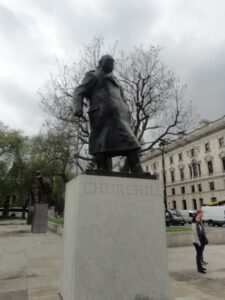
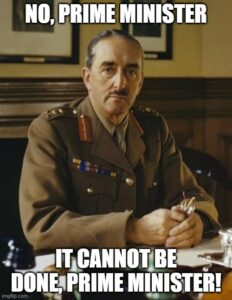
This statue (left) in Whitehall hasn’t been toppled as yet. It had better not be. The War On Churchill was begun in modern times by Tariq Ali and the BJP insurgency. (Well, they would, wouldn’t they?) In all save the war against fascism Winston was a moderate. Lord Alanbrooke (above right) was the CIGS during WW2, and gives the clearest picture yet available of that titanic struggle. He and Winston rowed frequently. Brooke spent much of his precious spare time practising the above protest. He wrote in his diaries that he might have been sacked three times a week. Yet he never was. Because Churchill believed that to sack his chief general would be to fall into Hitler’s blunder of believing himself infallible. In all else save the war on the Nazis he believed in moderation. He was even a trade unionist. His personal therapy at home was making and laying bricks. He applied for membership of the appropriate union, and they accepted him.
Not that his detractors believe a word of this. The Tonypandy Massacre, so-called, is a piece of mythology. Nobody was killed. The striking Welsh miners had broken out into acts of public vandalism. To this day you will read that he sent in armed troops to disperse the rioters. He did no such thing. He sent police armed with rolled-up mackintoshes. He is also blamed for the Gallipoli campaign. Yes, it was his idea. He was appalled by the senseless slaughter of the trenches and wanted to turn the Turkish flank. It would have worked had not the War Office inexcusably sat on their hands for three months, admiring the polish on their boots, while the Turks fortified the Dardanelles with everything they had.
Did he attempt to topple the war government who had sabotaged his plan? Nope. Instead he retired to the background and began investigating the possibilities of tank warfare. He didn’t invent the tank; but he managed to persuade the War Office that here was the tool to break the stalemate. Had he retired for good in 1945 when a war-weary electorate voted him out of office his repute would be largely blemish-free. It is always a mistake to make a comeback in your dotage. Yet he was hardly the first to succumb to the myth of the geriatric saviour. He wasn’t the last, either. For his indomitable courage and steadfastness, and his matchless rhetoric (inspired by his love of – and close study of – the speeches of Lincoln), he deserves to keep his statue in Whitehall uncontested. For the best movie on Churchill, have a look at Darkest Hour. Gary Oldman brings him brilliantly to life.
Why is moderation out of fashion? For this we can blame America. Americans have many virtues, but moderation isn’t one of them. The spectre of Cotton Mather still stalks through the haunted Puritan imagination to this day. Unfortunately we have begun to borrow their rhetoric. This is a capital mistake, and one we have all lived to regret. Examples? The excessive excitement about Woke and the furious backlash against it. Here’s another:
Defund the police!
What was originally intended was a response to police shootings, especially of people with deep suntans. The idea was that some resources should be diverted from police budgets towards assisting people out of the cycle of violence and imprisonment. Sensible enough, you might have thought. Once the extremists began to rabble-rouse with it, it became something altogether Other. Here’s how it might, and should, have played out:






That isn’t how it played out. What we got were asinine remarks like Name me a single thing a police officer can do that a social worker cannot! (Disarm an armed offender, maybe?) By refusing moderation this battle, like so many others, was horribly lost.
Moderation works. Long ago, I was honoured to play a brief walk-on part in the demonstrations to save the Franklin River. Having dammed all the rest of Tasmania’s wild rivers, the HEC turned their attention to the last remaining one. Tasmania was sharply divided, as was the town of Strahan at the epicentre of the conflict. The Wilderness Society ran a superb campaign of non-violent direct action to stop the dam. It was played out in the lounge-rooms of Middle Australia, and it worked brilliantly. Time has justified the insurgency. Unfortunately, there has not been another such campaign since. Because the klaxon call of extremism has poisoned the well. The electorate turns away in disgust, and the battle is lost. Over and over again. Emotion triumphs over reason, and provokes a furious counter-reaction.
The two major tribal groups now are the Enlightenment and the Counter-Enlightenment. I’m with the former: Voltaire, Edmund Burke, Pitt the Younger and so forth. If you’re silly enough to listen to Tom Paine, the latter two were on Team Counter-Enlightenment. The problem was that both he and his master Jean-Jacques Rousseau were card-carrying members of that faction. Never mind science and reason! Emotion is all that counts! And the murky shadow of post-modernism – born out of the rancid imaginations of Plato and Immanuel Kant and nurtured by an extraordinary gang of deluded philosophes – began to summon the impressionable minds of Europe under its darkened penumbra. Postmodern Man is a rampaging id on two legs. And we have seen him assume the Presidency of the United States.
Progressives meanwhile have succumbed to the Purity Spiral. Greens parties are exceptionally prone to this self-destructive process wherein the lust to expand the horizons of secular holiness means that suddenly gender/race/identity politics/today’s plat du jour become more important than saving the planet. The Purity Spiral is one reason that populist reaction is on the rise worldwide. When progressives turn on each other and behave like punchdrunk cowboys at the Last Chance saloon, the lumpenproletariat turns away in disdain. I am not saying that the latest issues may not be important. But tearing your Party asunder over matters which are not your core constituency is a terrible idea. You had one job. Promote, by any legal means, the transition to a clean, green future. Do not let the perfect be the enemy of good. Learn when to compromise, and when to stand firm. These are not easy decisions: but embrace the task at hand. Without a sense of history, progressivism evaporates into aimless neophilia. And without exposure to new ideas conservatism ossifies into mindless reaction. Some synthesis is inevitable. But do not speak of horseshoes and the like. The IS/Hamas cheer squad and our local neo-Nazis look the same because they are the same.
The mention of identity politics is a surefire way to annoy progressives, by the by. Too bad. It actually is a thing. And far too many folks are doing it. So-called conservatives are every bit as prone to defining themselves by their self-constructed tribal identity. We haven’t heard much from Viscount Monckton of late. He was for a time a leading spokesman for climate deniers. The noble lord is a classic example of identity politics. His logic, such as it was, is that the climate agenda was being pushed by the UN and the Progressive Ascendancy. The UN is evil; hence the climate agenda must be evil nonsense.
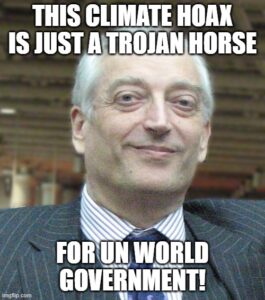

The ludicrous syllogism speaks for itself. And look, milord, I’m sorry about the unflattering photo, but … pretty much every picture I could find online made you look like a finalist in the Upper-Class Twit of the Year contest. The world at large did its best to give you a fair hearing; but you failed to convince anyone except those in the terminal stages of confirmation bias addiction.
Why is politics so terrible nowadays? It is a complex question with many answers. Ministerial Advisors are an obvious target. Ever since we were deranged enough to let these parasites in through the front door, government has become far more presidential, in the American sense, and far more corrupt. The hollowing out of the public service is an equally obvious consequence. When I worked for a certain government in policy and planning my first three days were spent, along with all of my colleagues, counting every road in the state of Victoria. Why were we wasting our time on this? Because the Minister’s Advisor wanted us to.
It was a blow from which I never really recovered my equanimity until I came to my senses and left the building. The problem goes far beyond Ministerial Advisors. The worship of managerialism has been a far worse blight. Mention the magic words Performance Indicators to any senior public servant and watch them wince. There used to be an entire industry devoted to fudging your PIs to make your performance look good. There may be still, although I believe they are now called KPIs. The name change hasn’t helped much.
But the cancer at the core of government is the plague of consultants. These companies are best seen as drug pushers:
Next thing we know, our hapless manager is telling the Board of Directors Hey! Look at me! I’m doing Manager Things! I’m hiring more consultants than ever! I deserve a massive pay rise! Outsourcing came into fashion nearly half a century ago. The promise was that it would cut costs. The ghost of Frédéric Bastiat was invoked to support this idea.
Sometimes it works. In government, generally not. And why? Because any advice given you by big consulting firms is hopelessly compromised by their own addictions, namely (a) insatiable greed for consulting fees and (b) their desperate desire to feel important and valued. Now it is terribly obvious that these creatures need to be driven out of government with platoons of police dogs, and barbed wire fences erected to make sure they don’t come back. Government is certainly too big for its boots, and takes far too much of our taxes. Getting rid of the media units, advisors and consultants; and putting one’s faith rather in public servants, will reduce the bill considerably.
About the whole public servant thing. In one of the management courses I once endured, the necessity for flat management structures was emphasised at length. The speakers who talked about this were absolutely right. The problem is that governments love to erect vast pyramids with hordes of middle managers in multifarious layers. These, too, must be got rid of. We need more worker bees and fewer drones.
Before I end this thread, I must emphasise that by no means all consultants are worthless parasites. The best of them tend to be semi-retired folk who know their trade thoroughly, have no wish for personal self-aggrandisement or Porsches, and merely want to help out because they like being helpful. The best I ever hired only wanted $50 for his one-hour seminar, plus $120 petrol money because he lived a long way away. In my capacity as PD coordinator, it was the best value for money I ever managed. It is tempting to assume that the utility of consultants is inversely proportional to the size of their bill.
On the topic of corruption, once upon a time in this Big, Brown Land The Rules were clearly understood and obeyed. Australia was a podium finisher in world rankings for honesty in government. Those days are long gone. Corruption has now become so endemic you will hear Cabinet Ministers saying things like this:

It’s never quite that explicit. But they insist that they did nothing wrong. Well, everyone does it, don’t they? You’re just jealous because you aren’t in government and I am. Once upon a time, Parliament was the bulwark of the common people against corruption and high-handed tyranny. Some folk still believe in this. But Parliament by itself can no longer hold corruption at bay. One of the first to recognize this was a forgotten hero of Australian politics:

Nick Greiner was once Premier of NSW. He knew perfectly well the extent of corruption in local politics. Things hadn’t changed much since the Rum Corps ran the colony back in the Dark Times. He established an anti-corruption commission with more teeth than the Mormon Tabernacle Choir. As a Hungarian émigré he knew all about totalitarianism and freedom. He told them to go after anybody and everybody. And they did. In a sorrowful cloudburst of irony, one of its victims was Greiner himself. Compared with some of the criminals who have occupied his chair he was Sir Galahad’s twin brother. But he handed in his hat without a whisper of complaint.
The NSW ICAC is still the gold standard for anti-corruption watchdogs. No other government has been game to establish one with such sweeping powers. But Greiner was right. If you want to do some serious agitation, urge your local MPs to get behind a beefed up ICAC with powers to investigate anybody, including politicians. Tell them to embrace their Inner Greiner. Let them know this isn’t going away until it’s fixed. When it comes to election time, please do not vote some Party ticket just because it’s your tribe. Do not vote a certain way because you loathe the incumbents. Please try to define yourselves by what you want, rather than what you hate. Hatred is a terrible curse. The solution is simple enough. Do not vote tribal. Find out who your representatives are and learn something about them. Are they worthy of your vote? Many of them are. Some deserve to be booted out. Hold them all to account. Democracy depends on it.
The other intractable problem is free flows of information: that concept most beloved of theoretical economists. Most of what we think we know comes from journalists. And yet journalism – like so many other ancestral pillars of our polity – is in free-fall. The hollowing out of media corporations in favour of infotainment and propaganda has poisoned the well, here and everywhere else. The Gish Gallop – pioneered by a lunatic Creationist – is now the plat du jour in American politics on the allegedly conservative side. What you do is speak very quickly, and bombard your listeners with a farrago of incredible nonsense so incoherent that fact-checkers are overwhelmed by the inexorable torrent of drivel. It is Donald Trump’s playbook.

It gets worse. The lies propagated by modern Commissars are not grotesque by accident. The more bizarre they are the better. They are a gate-keeping mechanism used to decide who is loyal, and who is to be purged. If you wish to be a Party member, you must swallow your pride and embrace things you know to be false. To see the Republican Party surrender to the Soviets has been, for conservatives, a time of anguish. The dissidents deserve our sympathy and encouragement. I never thought I would speak in praise of Dick Cheney, but I’m happy to now. He, his formidable daughter Liz, and a number of others (too few!) have spoken out against the new cult which holds that high treason is the new fashion statement.
Afterword: The Accord

The year was 1983. Australia had endured seven years of Soviet-style decline under a delusional Malcolm Fraser and his weary, sclerotic government. We were going nowhere fast. Bushfires had devastated much of the continent. And the federal election saw the advent of something new in Australian politics. A charismatic larrikin PM? Really? A notorious womanising drunk? And yet. Bob Hawke was so much more than that. The Accord of 1983 was the foundation-stone of decades’ worth of unexpected prosperity. Why not get everyone around a table, explain what needs to be done, and see if we can’t persuade everyone to give up something for the common good? There were some in the Labor Party who ran screaming from the room. Noooo! It’s messy, public suicide. The silvertails hate us and they’ll never forgive this. Don’t! Yet Hawke pulled it off. His charismatic genius won the day. He talked everyone around. Medicare was reinvented. The Superannuation Guarantee ensured that future generations need not be saddled with armies of mendicant pensioners. Unions gave up some perks and conditions and agreed to get back to work. Business grumbled, but signed up. And this Big, Brown Land began to breathe again.
It wasn’t just Hawke by himself. He was gifted a sensible, competent front-bench by his predecessor Bill Hayden, who nobly fell on his sword when requested to by the Comrades. Hayden was the brightest star in the ill-fated Whitlam government, and deserved better than he got. (Although getting a gig as Governor-General might have salved the hurt.) Many other Labor heroes worked punishing hours in the background to modernise the Party. (Jamie, if you’re reading this, your Dad was one of the quiet heroes. Others may have forgotten him, but I haven’t.) All this sounds a bit radical. Yet Hawke succeeded because it really wasn’t. It was the apotheosis of moderation. Because moderation doesn’t mean timidity. And it works, where windy rhetoric doesn’t.
Auden got that one right. Read the New Yorker, definitely.