People haven’t talked about Australian values for quite a while. Not since John Howard’s white-picket-fence 1950s take on the subject. Either we’re supposed to be ashamed of them, or else we’re not sure what they are. But since Australian history is not exactly the world’s most popular subject, I thought I’d have a bit of a lash at explaining what they might be. My first commercially published book, should you be interested, was called It’s True! Bourke & Wills Forgot the Frying Pan:
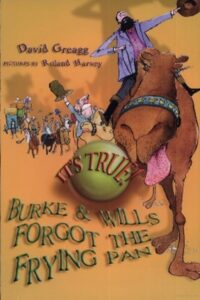
It was very kind of Allen & Unwin to give me my first break as an actual author. I hope I did not disappoint, but I do know a lot of people bought it, and (with any luck) read it. That title ought to be some sort of clue that I have no interest in mythologising any of our supposed national icons. I do love and admire my native land. There’s a lot to like. So please: no black arm-bands. But no living in denial either. There is not the slightest point in pretending we were peaceful occupiers. We were invaders like every other successful tribe on earth. The central issue for white folks agonizing about our history of dispossessing the natives is the feeling If Only I Had Been There! This emotional response is remarkably adjacent is a long succession of movies and stories about how a bunch of oppressed natives find salvation because a white man comes to their rescue.
This is a tedious narrative. It is why cultural studies majors have decreed that White Male Saviour is a term of abuse. They are not wholly wrong, either. The ancestor of this narrative – so beloved of Hollywood – is Fenimore Cooper’s The Last of the Mohicans. In the film version there is an excellent take on this. The viewer’s expectation – that Hawkeye will come to the rescue of the Colonel’s daughters – is brutally denied; because Hawkeye doesn’t speak Magua’s language. The translation, and martyrdom, is provided by the English lieutenant. Cooper’s narrative is a little sentimental; but mitigates the Noble Savage trap with commendable restraint. His book is not only the ancestor of Avatar, Dances With Wolves, The Last Samurai and all the rest of them. It is the best of them by a distance. But we need to stop telling these white male saviour stories.
Here’s a story from Australia which actually happened:
https://www.labourhistory.org.au/hummer/vol-3-no-4/yarri/
Black Male Saviour? Indeed. If you’d like a truly tragic tale of paternalistic colonialism, I can recommend Richard Trudgeon’s When Warriors lay Down And Die. It is the scarifying story of how white bureaucrats all but destroyed the Yolngu nation. I believe him, because unless he’s telling pork pies – which I greatly doubt – he was accepted by the Yolngu, and spoke some of their languages. It was always an article of faith in the British Empire that you were not permitted to be a colonial administrator unless you could speak at least two of the local languages with sufficiently fluency that you had no need to rely on interpreters. In Australia there were hundreds of languages. Some white folks learned them and made informal treaties with the locals.
But the most unloved position in colonial Australia was the title Protector of Aborigines. Most who took it on found the job excruciating. The government wished only to deal justly with all. The insatiable land hunger of the settlers made this impossible. If only you’d been there? You would have done no better. I did write a novel about this once; but it proved too hot a topic. Maybe one day my tale will reach the audience it possibly merits. But the Reverend John Gribble – otherwise only known for his walk-on role in the drama of Ned Kelly – certainly deserves to be better known.
There is still some dispute about the facts of our history. A welcome change in the tiresome rhetoric surrounding Aboriginal history was the publication of Dark Emu, by Bruce Pascoe. In his book, he extrapolated a handful of artefacts into a narrative of tribes not merely hunter-gatherers, but settled farmers. His book was largely debunked by experts who knew more about it than he did. His response was to welcome their criticisms and hope that further researches would shed further light on indigenous pre-history. By conceding that he had exceeded his evidence – something most scholars are guilty of at one point or another – and welcoming further exploration, Pascoe successfully poured cold water on the endlessly futile conflagration that is Australia’s culture wars.
And there was Governor Bourke. One tribal massacre by settlers which really did happen – there may have been fabrications, but pretending they didn’t happen is fanciful – was at Myall Creek. Governor Bourke insisted that the murderers be tried and hanged. It took several attempts, but it happened eventually.
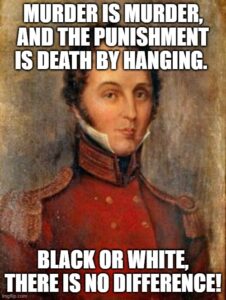
Sir Richard Bourke is all but unknown to Melbournians except for the street named after him. He was a passionate (though moderate) Anglican who devoted much of his life to improving the lot of persons of colour. Do look him up if you’re interested.
I will not say much more about Aboriginal history, because hey: I am no expert. Save this. Do not talk nonsense about Terra Nullius. It used to be understood by those who had had an actual education. Terra Nullius was the considered decision of a government who wished to grant lands to native tribes to save them from settler land-hunger. After exhaustive study, they found that land tenure among the tribes and nations was characterized by such a bewildering network of intersecting easements that land tenure, in the British sense, was not possible. They had hoped for so much more. And the squatters could not believe their luck. There was also the matter of whether or not Aborigines could be separately identified. If they could not, then they certainly could not own land. The corollary – that they could not be charged with anything at all in a law court – was missed at the time. (In my lost novel, my freedom fighter Mungo Gillespie explains this to the Commissioner who is trying to arrest him.)
Billions have been spent on Aboriginal welfare by well-meaning white folks. We have paid and paid. As Trudgeon’s book makes clear, these funds have been mostly either wasted, or been unimaginably destructive. Because it was spent by white folks on causes which they imagined to be for the benefit of the poor, ignorant tribes. Paternalism is never good. In few nations on earth has it ever been this futile. But the goodwill has always been there among the majority of Australians. When I was a child, Sunday afternoon TV featured the late Bill Onus, who told stories of his Dreamtime illustrated with his own pen drawings. It was Bill who was approached by well-meaning white folks wanting a Labour Day celebration:
So every year in March, Melbourne celebrates a Stick It Up Your Arse Festival. For many of us, this is singularly appropriate: celebrating as it does Good Larrikinism, unashamed bad taste, and awesome naïveté. Melbourne: I love you. Don’t ever change.
Australian history is filled with a strange myopia. Most countries do this. We do it far more than most. Consider Tom Wills. As Martin Flanagan’s book on him makes clear, he was far more than the man who invented round-arm bowling and started up Australian football. A mendacious account of his life and alleged crimes appeared in the USA, suggesting he had participated in a tribal massacre. Well, yes he had; but he was on the receiving end. He was one of a few survivors of a raid on his station. Did he seek revenge? He did not. He learned their language, was adopted by them, and took the very first cricket team to tour England. That team was headed up by Johnny Mullagh, the great all-rounder.
WG Grace was tremendously impressed, and said so. Grace was far less of a snob than he is often painted. Yes, he was a bit childish, and not above sharp practice. But the pros loved him, and tolerated his little ways. Because he always turned out for their benefit matches, ensuring a bumper harvest for their retirement funds. It ended badly for the tribesmen, as was more or less bound to happen. But not for lack of endeavour and goodwill from Wills.
He was a complex man, to say the least of it. But he gave us our national game. Marrngrook. Yes, it bloody is. Don’t argue. And AFL football – that’s proper football, as distinct from other weird versions which proliferate around the globe – is a heaven-sent opportunity for reconciliation. It is a game our brothers and sisters play with wonderful skill. And when some village hoon had the incomparable bad taste to shout the defunct cheese word at one of Our Boys, we all turned out in force to support him, and stand with him. Jamarra Ugle-Hagan kicked five goals that night and won us the game. That was a moment of reconciliation, and also of warning. There are still irreconcilables out there. It is as if Adam Goodes had experienced all that disgraceful booing, which he bore with commendable fortitude, for nothing.
We recently had a Prime Minister who claimed that Australia had never had slavery. Actually, that’s rubbish. But here’s the thing about so-called Blackbirding. Yes, that’s slavery all right. But it wasn’t government policy. And once we federated in 1901 it was suppressed. Thereafter, myopic paternalism and neglect resulted in an agitation, then headed by a Liberal PM, to make laws relating to Aboriginals. Including, among other things, the right to vote. It was passed at referendum by a vote of 90-odd %. Things didn’t get much better. We had Mabo: a basic restatement of Common Law rights. We had Vincent Lingiari, whose fight for tribal rights is commemorated in a federal seat named after him. Then we had some judicial overreach. We had louder voices. And we’ve had what any honest bystander would call an absolute catastrophe in Indigenous welfare. Throwing more money at it won’t help at all. We’ve tried that. The Voice was an attempt to fix things by actually listening to Indigenous folks. It was successfully howled down by a variety of folks, some of whom you really wouldn’t want anywhere near your barbecue. Some would have it that this was proof of our racism. A more charitable view is that 60% of the electors think that all Australians should be treated the same. As in the same-sex marriage plebiscite.
Although not everyone does wish our brothers and sisters well. The trouble really began in the 1890s in the days of the Bulletin. Sane students of Australian history find the Bulletin era profoundly distasteful. But it set up a dialectic which still holds surprisingly true today. On the one hand we had governments dedicated to serving their own sectarian interests and obsessions, but otherwise attempting to deal justly with one and all. On the other, we had a populist insurgency which was overwhelmingly jingoistic, nationalistic, racist and Blackshirt. The prophet of that insurgency was Henry Lawson: a tedious, moralizing drunk subject to fits of alcoholic afflatus. It tells you a great deal about Australia then that both he and Banjo Paterson were adopted with enthusiasm by their countrymen. (It is doubtful how much appeal the former had for Australia’s women. In a thunderclap of irony, Lawson’s own mother was a pioneering feminist.) They didn’t get on. It was impossible that they would. Lawson absolutely loved the idea of the bush. He found the reality dirty, messy and disappointing, and said so. Paterson’s spirited rejoinder was duly published in the pages of The Bulletin.
http://www.middlemiss.org/lit/authors/patersonab/poetry/indefenceofbush.html
Unlike the melancholic Lawson, Paterson was successful at everything he attempted. He got on well with everybody. He was a moderately prosperous solicitor when he wasn’t writing bush ballads. He was a clear-eyed realist capable of broad sympathies. When Australia went to war in Palestine he insisted on volunteering, despite being over fifty, which was then semi-dotage for most. He was promoted to major, and in a refreshing burst of common sense Chauvel – Allenby’s Australian deputy – put him in charge of the horses. The famous Charge of the Light Division to relieve Beersheba was partly enabled by none other than Banjo. If anyone tries to tell you about traditional Aussie values, please emend this in your head to the values of Paterson rather than Lawson.
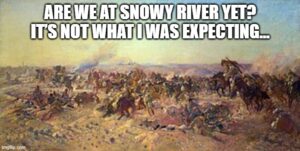
This curious cognitive dissonance is doubtless shared by many other nations. But I will suggest that few display it to quite our extent. The next inkblot on our national history landscape was Manning Clark’s six-volume valentine to himself, which he called a definitive history of Australia. It was supposedly all about the old, dead tree of British rule and the live green and yellow wattle of young, thrusting, testosterone-enhanced manhood. Yes, fine, whatever. Clark was an extraordinary fellow. On meeting him one day at the cricket, one contemporary hailed him with the following:
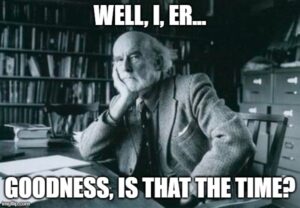
His father was a working-class clergyman. His mother was genteel; from the family of Samuel Marsden, the infamous Flogging Parson of early colonial days. It is not disputed that he preferred his father’s humble piety and bitterly resented the bullying he received at a certain Establishment school. (I was a poverty-stricken scholarship boy at the same school. The bullying I received there for being poor was far less than it might have been. Children bully. It’s what they do, until they grow out of it. I shrugged it off. It appears that Clark didn’t.) His revenge on the upper-class snobs was long in coming, and served at well below room temperature. And, as his long-time editor Peter Ryan remarked, where the facts didn’t fit his narrative, he made up new ones which did. Which rather begs the question, does it not? You were his editor, sport. Why did you wait until after his death before telling us? Local poet Chris Wallace-Crabbe penned an amusing limerick on that very point. You will find it in the Meanjin archives, if you wish.
The weary, exhausted spectre of Bulletin nationalism received an enormous boost from Clark’s immense work. His inventions are not all that important save that they underline his compelling need to reject Britain and all its works. His work is far more fatally flawed by its tiresome polemic. Now all historians have an axe to grind. I certainly have. I wish to tell you of Britain’s grandeur, and how much we can learn from it. But you cannot build a house upon sand. There is nothing to be gained by falsification, or pretending that facts don’t matter. Even Livy – the shameless aggrandiser of Augustan Rome – does not shy away from ugly facts which subvert his narrative. Veii, anyone? Yet Clark’s mysterious magic has infected the spirit of most of our leading republicans. Everything wrong with our history is Britain’s fault. Everything we did well is down to us noble, fearless, Antipodean lads. (Yes, it’s usually lads.)
Only thus could we have incubated the otherwise inexplicable myth of the Eureka Stockade. Other nations find the local obsession with a revolt by a multinational force of xenophobic tax evaders incurably quaint. The facts are baldly stated. In the 1850s, Victoria had a gold-rush, inspired very much by a similar one in California. We had a Governor (Charles La Trobe) who had remarkably little idea how to deal with it. During 1854 it became apparent that the colony of Victoria’s finances had sprung a leak. Actually, it was more like a torrent. The much-hated goldfields license fee was iniquitous and stupid; since only a small number of highly successful miners could possibly afford it. What was considerably worse was that nobody seemed to know where all the money had gone. Even after most of the dodgy loans made by the administration had been called in, there was still well over a quarter of a million pounds unaccounted for.
Unsurprisingly, La Trobe was removed from office. His successor Sir Charles Hotham was a Royal Navy officer brought up in the Nelson tradition. He called in all the loans (or ‘imprests’ as they were termed), put an end to the shameless looting of the public purse, and actually asked the miners for their opinions. He soon realized that arrogant officials on the goldfields were exacerbating conflicts there, and resolved to pay attention to the miners’ grievances. The miners then demanded the release of some of their imprisoned comrades who had burned down the Eureka hotel.
While Hotham was sympathetic – since there were extenuating circumstances relating to a corrupt magistrate – he could not possibly give in to demands like that. (You don’t remain long on the quarter-deck once you start giving in to bullies.) He announced that a properly worded memorial would be given due consideration. The miners were furious, and raised a rebellion at Bakery Hill, which was put down in fifteen minutes by three hundred-odd troops and police sent by the Goldfields Commissioner. Twenty-two diggers and six soldiers were killed. Once the rebels surrendered there were no reprisals, and no indiscriminate killings. The rebel leader (Peter Lalor) became a reactionary MP.
Now here is the strangest thing of all. The facts relating to the rebellion are barely disputed by anyone. And yet. If you read almost all the history books you will hear that it was a defining moment for Australia; the foundation-stone of Australian democracy; and so on, and on, and on. What it actually showed was that British justice was alive and well. Would that British rule in Ireland had been so merciful! Only thirteen of the arrested rebels were tried. Justice Sir Redmond Barry is best known as the man who sentenced Ned Kelly. He also tried the Eureka rebels. He told the jury that anyone found guilty would be hanged, drawn and quartered.
Yes, that barbaric punishment was still on the statue books. It wasn’t used any more, and hadn’t been for a long time. (It was officially abolished in 1870.) This is supposed to indicate that Barry was a bloodthirsty monster. Naturally the rebels were all acquitted. If you believe that this was *not* what Barry wanted, then I have a bridge I’d like to sell you. Somebody had to be tried. Of course they did. They were as guilty as all get-out; but Barry was clearly a believer in the legal maxim Interest rei publicae ut sit finis litium. Go away and sin no more, in plain English. Afterwards Hotham abolished the miner’s fee, replaced it with a levy of one pound per annum and raised needful revenue by taxing gold at the point of export. Half of the Ballarat police and almost all of the commissioners were dismissed for being corrupt – which they certainly were – and Hotham resigned next year, having done both his government and Victoria signal service.
Were the Eureka miners really the heroes they have been painted? Nope. They have been fortunate in their mythmakers. And for too many years nobody even wanted to talk about the Chinese. My beloved has dealt with this far better than I ever could, most notably in her book The Castlemaine Murders. Lambing Flat in New South Wales was renamed because Chinese had been massacred there, and Her Majesty’s government decreed that the town was stained with murder, and must henceforth be known as Young. The same thing almost happened here in Victoria. The man who prevented the massacre was only known as Constable D24. It took Ms Greenwood (and her mother Jeannie) a great deal of research to put a name to Constable Thomas Cooke. Thanks to her agitation, and that of the Victoria Police Historical Society, Cooke has his rightful memorial at Castlemaine police station:
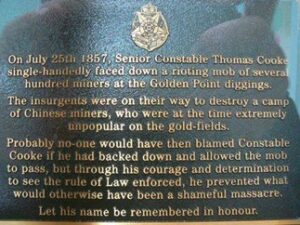
He received no thanks at the time. The thwarted mob returned to his police station and broke all his windows in disappointed rage and frustration, and he was obliged to meet the repair costs himself. Drop by and pay your respects, if you happen to be in the neighbourhood. Kerry’s book Journey to Eureka is also a fine young adult account of that turbulent epoch.
Nobody seems to want to talk about the Bendigo goldfields. Things were very different there. They had their own miners’ flag. Unlike the fatally compromised Eureka standard, the Red Ribbon flag may still be displayed with honour:
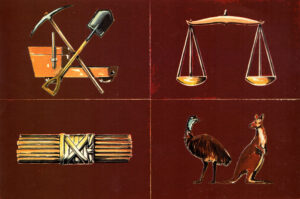
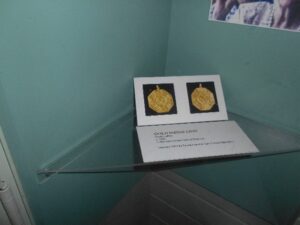
The Red Ribbon movement was every bit as militant as the Ballarat insurgency, with one crucial exception. Armed rebellion did not happen. And when the Governor announced his reforms, his carriage was pulled through the streets of Bendigo by the euphoric citizens. Why was this? I would suggest to you that the chief difference was that corruption – unimaginably rife in Ballarat – was all but unknown in Bendigo. Officials there were on the whole scrupulously honest. If you visit the Bendigo Chinese museum you may see a gold medallion presented by the Chinese miners to a certain police officer named Frood. (above right) The story behind this is not known. But it is a singular and inspiring artefact.
Corrupt officials have been a fact of life in Australia, as elsewhere. One of our earliest insurgencies was the Rum Rebellion of 1808. Look it up if you don’t know it. It was a military coup by a greedy and unbelievably corrupt gang of miscreants. Britain should not be blamed overmuch for allowing matters to deteriorate so dreadfully. They were in the midst of the Napoleonic War at the time. They did care enough about their distant colony to send Lachlan Macquarie with a company of proper troops to restore order.
Australia has much to be proud of. We led the Known World in rights for workers:
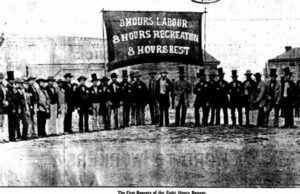
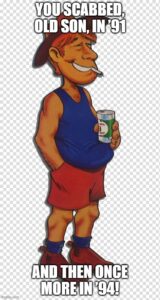
The backbone of this insurgency was the trade union movement. Which was a British invention, and one enthusiastically embraced here. And while scab labourers were socially shunned (see above right) there was little violence against them. Just shunning. My football club once refused to sign a champion player because he’d been a scab. It’s not a pleasant term for a non-union worker; but there it is. Refusing to join the union means stabbing your supposed mates in the back. I have a personal history here. I was once a union rep in my workplace. The boss told us that he was going to give us all extra work for no extra pay, and would we (the management committee) vote in favour? I told him that it didn’t matter what I thought. As we both knew, the members had met yesterday and voted his proposal down. He went ahead and did it anyway. But I did not backstab my mates. Union officials may not second-guess the members they represent.
We also led the world in our measured and studied response to an attempted assassination. In 1868 a deluded Irish-Australian youth attempted to shoot Prince Alfred.
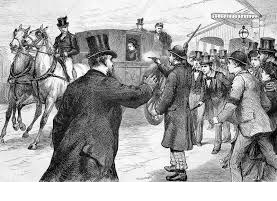
The result was a great outpouring of patriotic fervour. This was the origin of the multitude of Australian pubs named after the intended victim. There were public meetings into which the clergy attempted to deal themselves, and were told No, this is a purely lay matter. Youse mob stay out of it. Nowadays, one greatly fears, the response would have been to call for a pogrom of treacherous Paddies. In the more civilised 19thC, Australians joined hands and said NO! We will not tolerate anti-Irish sentiments just because one poor lad with mental health issues lost his head. No, we are all one people. Let’s join hands.
Henry Parkes attempted to parlay this affair into a repressive regime, and raised the spectre of Fenian conspiracies. Australians folded their arms and said:
Really? Where are they then? Where’s your proof? You haven’t got any, have you? Get outa town, sport.
May it be that this collegiate spirit might animate Australia once more.
I will pass lightly over many of our other supposed national icons. The inexplicable worship of Ned Kelly is very much on the wane these days, and a fine thing too. Those who shoot policemen ought not to be heroes. The other great supposed Birth of a Nation at Gallipoli is now generally overshadowed by the deeds of Sir John Monash, Harry Chauvel, Pompey Elliott, and (later) Thomas Blamey. This is very much as it should be. Australia has always punched well above its weight in war. And this is a fine thing. If we can persuade people not to punch down, this would be a fine thing indeed.
The one virtue which has coloured our history more than any is moderation. During the Great Depression we had a White Army once, comprised of tens of thousands of ex-Diggers. They were well-armed, and all ready to overthrow the government and instal a dictator. Would Australia follow Italy and Germany, and succumb to authoritarian dictatorship? No, we didn’t. There was talk in the 1920s of having General Monash as our dictator, but he – a loyal Aussie Jew! – wasn’t having a bar of that. The movement petered out in the Thirties, in the absence of any charismatic leader selfish and ruthless enough to take advantage of their credulity. May it be so during the next great insurgency, *fingers crossed*
We are a land of migrants. Most of those who come here like what we do. The inexorable march of Americanisation has been very bad, and we are the poorer for it. Here’s a piece of pop-culture you may not know. Americans love their cartoon heroes. While the USA drooled over Superman, Batman and other assorted fabrications, what traditional Aussies preferred was a cartoon called The Phantom. The Walkers were not supermen. They were hereditary heroes who guarded the Skull Cave, punished malefactors, and maintained friendly relations with the pygmy tribes, whom they treated not merely as actual humans, but crucial allies. The Ghost Who Walks was understated, and British in the best sense.
My home town of Footscray is traditional Australia writ small. Here is what my Beloved wrote of it:
https://kerrygreenwood.com/my-home-town/
This is who we are. We are British, but with the crucial difference that we managed to avoid many of the Old Country’s blunders and missteps. Why do you English keep wanting to put the boot into the Irish? Are you out of your minds? No, mate. We aren’t playing. Some of our squattocracy wanted a hereditary peerage here: House of Lords and all. No, sport. Youse can have it in Britain, but not here. It isn’t who we are. Forget it. One of Kerry’s ancestors was a Scots stonemason who built himself a house in his spare time. He enquired of a local official to whom should he pay rent? No, you don’t pay rent to anybody. This is the Land With No Lairds. Scots Gaelic (Gàidhlig to us) was still spoken in Footscray until 1900. This is why it is my preferred tongue for needful spells. Australia’s appeal to oppressed Highlanders was obvious. No wonder they flocked to our shores. And this, surely, is what we ought to be. We need to stand up to the plutocracy and the rent-seekers, fold our arms, and tell them no. No bloody way!
By the way, the Australian business establishment used to be a great deal more egalitarian than it has now become. CEOs were much cleverer and more innovative back in the day, and did not share the modern delusion that they were godlike beings who deserved kings’ ransoms in salary and stock options. And the Melbourne Cricket Club – of which I am a member – is a place where all members are equal. When our entry forms were being signed by a textile magnate, he turned to a man sitting by him, and said: ‘Oh, Arthur? Will you co-sign these forms for Ted’s grandsons?’
Arthur Calwell MP, leader of the federal Labor Party, signed with a flourish. They may have been class enemies outside, but in the Members’ all such matters are left at the front gate. Australian values! And here’s a few traditional virtues I’d like to see more of:
- When you come to live here, leave your Old Country crap behind. We don’t do this here. If you’re not prepared to do that, pack your things and go annoy someone else. You don’t have to forget who you were, and are. But we don’t kill each other because of stuff halfway across the bloody globe.
- Everyone should be able to afford a roof over their head. Property values have been propped up by insane policy settings for far too long. House prices need to be halved. Not overnight, but over say ten years. Taking investment capital out of productive endeavours into house profiteering is bonkers.
- Our national debt is around a trillion dollars. Our superannuation pot approaches five times that. Would you take a 20% haircut so future generations don’t have to pay for our profligacy? I’m game if you are.
We used to be a post-postcolonial country. If you have not heard of the term, it was devised by a French PhD student, who wrote a thesis on my Beloved’s most famous character. She described the world of Phryne Fisher as Post-postcolonial. It is a very theoretical essay, but a fine piece of work nonetheless. If you’d like a Trad Aussie Bloke summary of it, here it is:
- Colonialism: Your land is ruled from afar by blokes you can’t stand, and you’d like to be rid of them.
- Postcolonialism: The bludgers have left, but you’re still whingeing about it.
- Post-postcolonialism: We’re over it now. If others aren’t, then that’s fine with us and they can buy their own beer.
Australia became a fully independent nation in 1931 with the Statute of Westminster. Our government didn’t actually promulgate it until the Forties. And why? Because we already knew we were independent. It was no big deal. Empty symbolism of the type so beloved of later politicians didn’t interest them. We have been sleep-walking towards calamity for many years now. There are many ways we could snap out of our sun-kissed delusional slumbers. Let us remember who we are. It is not that different from who we used to be. We must reject the lunacy of MAGA America and plough our own path through these troubled waters.
Finally, I thought I might share with you one of my favourite tall stories. Traditional Aussie humour at its best: dry, laconic, and with a great punch-line. Consider a country town. It might be Bourke, or Walgett. It might even be Piper’s Flat, though that’s another tall story all its own:
http://www.middlemiss.org/lit/poetry/mdougal.html.
Let’s call it Molongo then. Country cricket had a great many rules, one of which was that you weren’t allowed to retire until you’d found a replacement player. One day they had a match against Nine Mile Creek. They could only manage ten players, but one of the farmers volunteered to bring along his horse as eleventh man. ‘What can a bloody horse do?’ enquired the captain. ‘You watch,’ said the farmer. ‘He’ll do all right.’
Sent in to bat, Molongo were nine down for twenty in no time at all. The captain sighed, and watched from the non-striker’s end as the farmer’s horse was equipped with two sets of pads, and allowed the farmer to insert the bat handle into his mouth. He trotted out to the wicket and proceeded to whack the bowling all over the park. Molongo cheered. The bowlers were soon at their wits’ end. When the captain’s stumps were shattered Molongo had raised the hundred.
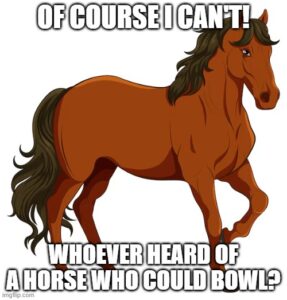
Nine Mile Creek then set about the Molongo bowling. The horse cantered around the outfield and saved many boundaries, kicking the ball back with his front feet. At none for fifty the captain approached the horse and asked: ‘Can you come on to bowl at the pavilion end?’
Our Flag
Here’s a thought. Why not devise a new one representing life in Australia as it is now? Let’s start with a deep blue background, representing the desert sky at night. Let’s put in the ancestral sky father Biame, the protector spirit Mirabooka, and the gum tree Yaraando. All these are represented by the same constellation, thus combining myths from many indigenous nations. We need a single star representing Bunjil the Eaglehawk (variously Altair or Fomalhaut in different places), so let’s put that down the bottom left. Top left? The migrant experience. Let’s add symbols representing an escaped slave who went back to the land of his captivity and preached successfully to his former captors. Add a Greek warrior-saint and a Middle-Eastern apostle for our Mediterranean friends. Looks pretty good to me. Overall extra cost? Zero.