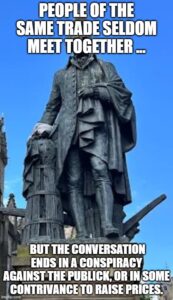
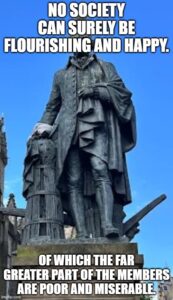
These wise words – warning against corporate oligopolies and in favour of high wages – do not come from some Bolshevik agitator. The speaker is Adam Smith, author of The Wealth of Nations and high priest of classical liberalism.
Capitalism today is a swear word. It shouldn’t be. Yet it is, for one horribly simple reason. Capital is completely out of control. No sane person thinks Capital should be allowed to do whatever it likes. Yet our new masters – one and all disciples of Peter Thiel – think exactly that.
The world’s richest folks don’t believe in classical liberalism. What they like best is a combination of monopoly capitalism (crush your competitors and then charge whatever you feel like) and crony capitalism (make sure that the government does your bidding and deals you into anything you want). This wasn’t how it was supposed to go. The result is a world where wealth inequality is raging out of control. The world’s tech titans are bad enough. Arguably worse are the managerialists. There are multibillionaires out there who have invented nothing. What is they do, exactly? No-one really knows. They speculate in capital markets, or else they provide a mystical alchemical sauce called Management. Nobody knows what it is, but for the oppressed peons its taste is bitter.
This essay was originally far longer, by the by. I have edited ruthlessly, since policy wonks don’t need it and the rest of you might well run screaming from the room. So here is a brief summary:
Capitalism proper really does work. Unlike the metaphysical moonshine offered by starry-eyed visionaries, capitalism is responsible for the fact that in more or less functional societies, the masses have been delivered from the miserable poverty which has been humankind’s lot from the dawn of time.
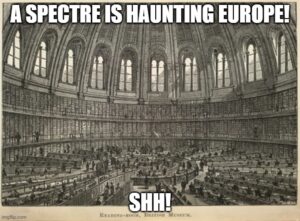
Marxism doesn’t. Herr Marx seems never to have understood the concept of gains of trade. The idea that people trade goods and services because both parties have much to gain and little to lose from the transaction was a closed and cremated book to him. And he never envisaged the Theory of Marginal Utility, which by itself invalidates much of his depressingly pedestrian analysis.
Why is capitalism better than state-imposed socialism? The former assumes that left to themselves, rich people will inevitably form oppressive oligopolies. This is why we have market regulators, some of whom do their job and some conspicuously don’t. Adam Smith’s contempt for joint stock companies ought to be better-known than it is. Naturally people will seek to enrich themselves unfairly at everyone else’s expense. A sane polity accepts this and creates rules which punish those who misbehave. The underlying assumption of Marx-inspired polities is that once we’re all living in a socialist paradise then everyone will work for the common good. This is about as sensible as a gazelle asking a lion not to eat it:


Command economies don’t work. From Lenin to Maduro the tale is depressingly uniform. Brutality, poverty, incompetence and corruption. Socialism isn’t necessarily bad. There is a galaxy of difference between Maduro’s Venezuela and the social democracies of the First World. Democratic societies generally vote for a social-democrat style of government. Which means welfare. Once upon a time in Europe it was the Church who managed welfare. But as cities grew from villages into megapolises, all the old institutions could no longer cope. Welfare is never good. Are we stuck with it? Yes we are, for the present. I fear that in future there may not be any, because most governments across the world are neck-deep in debt, and sinking further with every passing minute. I hope we never see a time where it disappears. It will be a world of nightmare and horror.
Tax the rich! the cry goes up. Well yes. I don’t believe there is any alternative. But where capital flight can happen at the flick of a mouse, that is far easier said than done. Adam Smith has the solution, by the by. He argued for a broad-based land tax. Unlike capital, land cannot run away. This isn’t socialism. If it’s in Smith’s book it can’t be socialism, surely? Smith also believed in public goods, defined as services for which there is no excludability. He has a whole list of them, beginning with defence of the realm. He would be astonished at the fact that we allow tax deductions and subsidies for club goods. That needs to disappear.
Tax rates, by the way, are not nearly as simple a matter as people think. In pre-Thatcher Britain, the top marginal tax rate was 83%. For so-called unearned income it was 98%. This does not work. During the unpleasant counter-revolution which followed, the top rate was cut to 60%. Revenue increased. Of course it did. The Laffer Curve is real, although the sweet spot is notoriously elusive. Nowadays we try to keep it under 50%. Tax is always a disincentive. So you should tax land and resources. Because they don’t run away.
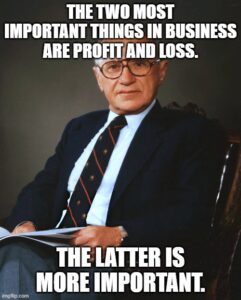
The speaker is the much-reviled Milton Friedman. On this he was absolutely right. Moral hazard is when people are encouraged to take foolish risks because they know somebody else will bail them out if it goes pear-shaped. He would have been appalled by the GFC bailout in 2007. At the time, the only people who protested were socialists and economists. What the world told the capital markets was this. Go ahead. Take all the risks you want. When it goes bang again, the taxpayer will bail you out. Bailouts are a terrible idea. The Icelanders got it right when they nationalised what was left of their banks and put some of the bankers in jail. Auditors signed off on these stinkingly decaying accounts the world over. How many of them went to prison?
All I will say of the Austrian school of economics – founded by Ludwig von Mises and his disciple Friedrich Hayek – is this. Yes, it has no possibility of self-improvement. (Just like Marxism.) Their thesis was that governments do not and cannot possess enough information to allocate resources efficiently. Leave it to the markets. The century since, it would appear, has been devoted to an attempt to prove them wrong. These days private corporations don’t allocate resources efficiently at all. Are they any better than governments now? It seems not. After all, the executives private and public all seem to go to the same business schools. The most important economist in recent times was Ronald Coase. He explained this as follows:
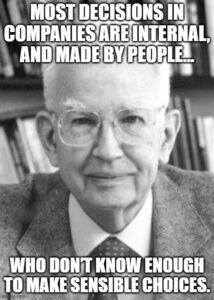
Quite. And Hayek’s Road To Serfdom continues unabated. Instead of the postwar planners who infested Europe in his day, we now have allegedly private companies whose Soviet diktats all too often are paid for from our taxes. Sovietism is always bad, whoever is doing it.
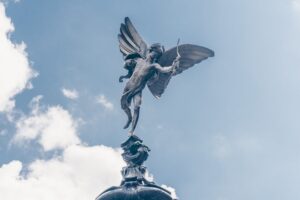

In London’s Piccadilly Circus the above statue was inexplicably placed to commemorate an all but forgotten hero of Britain. Anthony Ashley-Cooper, 7th Earl of Shaftesbury, was an Evangelical Christian of a type which has all but perished from this earth. (The term now seems to mean either a whited sepulchre, a consummate hypocrite, or both.) The Industrial Revolution was the engine which allowed Britain to defeat Napoleon. Its wretched victims – the benighted factory workers – lived lives of unremitting horror. And this, said the noble lord, is intolerable. It is against all the laws of God and must not be allowed.
He was far from alone in this. Inevitably, the Society of Friends was also at the forefront of the movement. The first Factory Act was passed in 1802. By 1847 the Ten-Hour Act was passed, limiting daily toil to a maximum of ten hours. Inevitably, business leaders yelled the House down. We’ll all be ruined! They said the same things about the abolition of the slave trade. Shaftesbury and his team stood their ground. As you might have predicted, productivity soared when workers were allowed more rest.
What this showed was that business leaders should not be allowed to have a free hand to work their employees to death. Capital needs guard-rails. Perhaps somebody might mention this to the business moguls who rule over us now. And when they proclaim their alleged Christian virtues, ask them to put their money where their Saviour might wish to direct them.
Afterword: The Benefits of Nationalisation
One of the things we really do know about nationalising industries is that eventually it puts them out of business. Score one to von Mises, except … why on earth do we not use this powerful weapon more sensibly? Drugs? Tobacco? Nationalise the lot. Undercut the crime syndicates and use the profits to fund the health system. That way you raise money and cut the criminals out of your economy. Why is this not happening? Ask your MP.