Croeso Y Gymru!
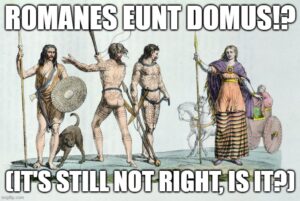
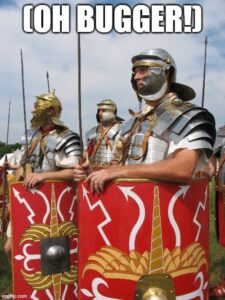
In the year 43 the Romans got serious about conquering Britain. One by one, the tribes succumbed to the invincible legions. The Celtic tribes were either conquered, or else retreated westward. One should not romanticise them overmuch. When Boudicca’s Iceni were brutally mistreated by an idiotic Roman governor, the warrior Queen’s response was to massacre the entire populations of Colchester, London and St Albans. She now has a statue on Westminster Bridge:
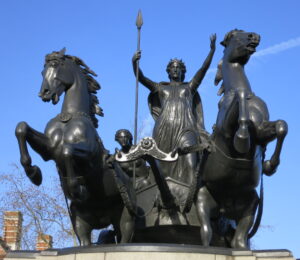
The English do love their freedom fighters, and underdogs. It is one of their best qualities. And, to be frank, one does see Boudicca’s point, to a degree.
Claudius’ invasion was spurred by Caratacus’ conquest of the Atrebates, who then appealed to Rome: a decision they may have come to repent. Caratacus’ stern resistance to the Romans lasted many a year. He was taken to Rome in chains, and doubtless expected execution. But the Welsh pride themselves on their oratory. With an impassioned speech to the Senate he gained his freedom, and Roman citizenship:
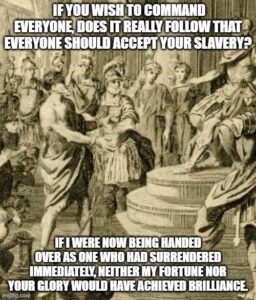
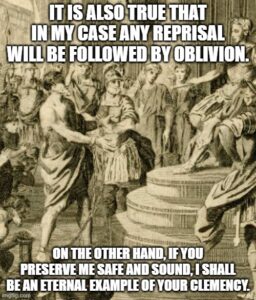
The Romans loved their noble savage ideals. And they really loved a good speech. The modern Welsh adopted Caratacus as their role model, which is the origin of the name Caradawg. But a pattern was developing which was to be repeated throughout Welsh history.
- Fight bravely to the end of your strength for your independence.
- If this fails, make whatever terms you can get.
- When you make promises to your new overlords, keep them.
The English don’t understand the Welsh at all, even less than they understand the Irish or the Scots. But somewhere buried in the heart of their incomprehension lurks the idea that these incurably strange folks with the funny language are actually on our side.
I will now take you through a brief summary of Welsh history in order to show that this is a massive understatement. As mentioned elsewhere, the p-Celtic tribes were driven back into Wales and Cornwall by the invading English. Although not quite, since the kingdoms of Rheged (Lancashire and Cumbria) and Strathclyde (southwest Scotland as far as Glasgow) lasted far longer. The battle of Brunanburh in 937 was however a decisive defeat for them, and their days were numbered thereafter.
Wales proper remained the heartland of Celtic Britain. And look, it’s spelled Cymru (pr Come-ree) and their tongue is called Cymraeg. Do try to get it right. The earliest literature we have for them comes from the 6thC bard Taliesin. It makes grim reading. Dark indeed was Cynddylan’s hall tonight. And when men went to Catraeth it ended horribly for them. The English were too strong, too formidable, and too numerous. Yet the Welsh preserved their independence in their ancient heartland until the bloody Normans turned up. The 13thC conquest by Edward Longshanks was a sorrowful tale of self-delusion by the last prince of Gwynedd (Llewellyn ap Gruyffydd), who imagined that he was the reincarnation of King Arthur; and his utter inability to restrain his idiot brother Dafydd from raiding into England. You just don’t do that to Longshanks.
Most tourists are obsessed with the castles Longshanks made the Welsh build all around the edges of the country. When I visit Wales I prefer to visit the ruins of Castell Dinas Bran, built by Madoc ap Gruyffydd to help keep off the heathen English. And yet Edward’s vengeance on his defeated enemy stopped in its tracks with the castles. To this day, it is lawful to plead cases in Welsh courts in the vernacular. The principality of Wales was retained, with the title conferred on Edward’s infant son. And the Welsh with reluctance accepted what was imposed on them. It could have been far worse.
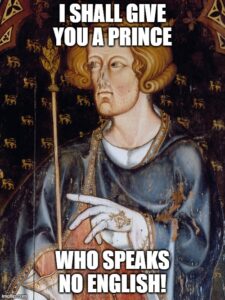
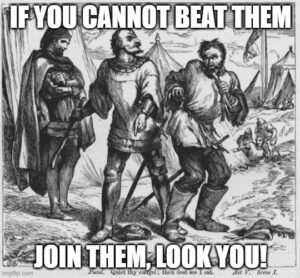
The longbow of Gwent, and the heroic resistance of the outnumbered Welsh, meant that it took Edward ten years of hard fighting to conquer Wales. He respected resolute foes. As long as they kept their word when given, he extended the hand of friendship. The Normans could not have won their Hundred Years’ War battles without Welsh bowmen. And here is a curious fact which has been allowed to pass all but unnoticed. After the Lancastrian usurpation Owain Glyndwr raised a rebellion which lasted many years. Twice he was offered pardons if he would but surrender. He refused. His ultimate fate is unknown. There were no reprisals to speak of. From the viewpoint of the Normans, Owain had never broken any promises. We don’t blame you for wanting your freedom. Please: just stop. Norman kings had come a long journey from the scarifying cruelty of William the Bastard.
During the English Civil War, Wales was staunchly Royalist. They kept up the fight far longer than most. As a nation they had given their word to fight for the King, and they kept it. The Royal Welch Fusiliers became an honoured regiment in the British army. The Welsh don’t boast, and by and large they don’t whinge either. They simply get on with the job.
Praise God We Are A Musical People
One of the greatest of medieval poets was Dafydd ap Gwilym. His work remains all but unknown. It took George Borrow, of all people, to proclaim his greatness to the English. He explores the contradictions of being a subject people, feared (with good reason!) and mistrusted by the English. In the modern era, the greatest of all English poets was born in Swansea, and lived most of his short life there. As a human he really was a bit awful. Great poets frequently are. And how is Dylan Thomas remembered? As a drunken pixie who once wrote a dubious radio play.
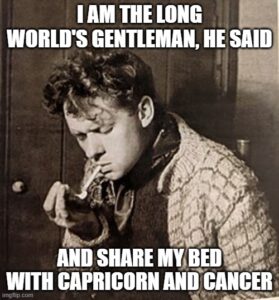
Really. If you care about poetry at all, get hold of his collected poems and start reading. I See The Boys Of Summer is the first, which he wrote when he was sixteen. It is like a flash of lightning on a summer night. And he got better. His last few poems (Poem in October, Poem On His Birthday, In the White Giant’s Thigh, Sir John’s Hill etc) are magnificent beyond words. His poems are rarely read. They demand considerable intellectual effort which goes far beyond his adroit use of transferred epithets. If you would rather sit back and merely let his rolling thunder thrill your senses, then this is also acceptable. Great poetry should have you rocked back in your chair, dazed and stunned. Thomas does this better than anyone since Shakespeare. Listen to Under Milk Wood if you must, but remember him for his matchless verse.
In his own life he was regarded as a dissolute flaneur who threw together obscure lines which don’t really mean anything and went off to get royally pissed. In reality, he spent long hours painfully labouring in his tower of words day after day. In the evening he wandered off for a few pints of Welsh bitter and – eventually – returned to his long-suffering wife. If you don’t believe that, have a squiz at his notebooks. Almost every word has been emended more than once.
Wales and Welshness have become a blank canvas for fantasists of all descriptions. I have met many a deluded student who imagines that the Mabinogion is a description of a forgotten Welsh paganism, rather than what it actually is: a sophisticated European romance sequence. The final tall story (The Dream of Macsen Wledig) describes how the self-styled Roman emperor Magnus Maximus did not perish at Aquileia, but went on to conquer the entire Roman empire. Everyone knew that this was a fantasy. The key is the magic word Dream: a nuance perchance thrown away on the gullible. Fantasise if you must, but do remember to take reality checks. And do, please, enjoy the tales of Brother Cadfael. They are not exactly historical, but close enough for comfort.
Wales today retains a form of independence. Anti-English sentiment has been largely confined lately to occasional conflagrations of uninhabited holiday homes. Like the equally civilised folk of Occitania and Breiz, the Welsh do not indulge themselves with terrorism. Cymraeg survives, thanks perhaps to Welsh language TV. Standing on the railway station at Plas Newydd (Newport) during my last visit I listened as the PA announced arrivals and departures in the vernacular first, then in English. And a fine thing too. (Should you go walking in the countryside and begin to wonder where the hell this place Llwybr Cerdded is, it means Walking Track.)
And should you wish to comprehend this stalwart and indomitable people, the best film suggestion I can offer is The Englishman Who Went Up A Hill And Came Down A Mountain. It is a true story, and it has Hugh Grant in possibly his best ever role.
Cymru Am Byth!