The Darksome Mere

Back when I was studying Beowulf, we were thrilled by the graphic description of the darksome mere into which our hero dives to seek out the terrifying mother of Grendel. It reminded me of the noisome swamp into which many of my fellow students were descending in their cultural studies courses. It is no secret now that modern (or postmodern) Humanities are poisoned at the root. I avoided them for years. No thank you! In one of my Old Norse seminars we got up to the bit where the avenging mob lights fires outside Njál’s house. Is it one fire or many? my tutor enquired. The text says stór bál. I got a brownie point by suggesting it must be more than one fire, because neuter adjectives have a t in the accusative singular. One big fire = stórt bál; many big fires = stór bál. Philology is a science. Things are either right, wrong, or (rarely) contested. Unfortunately if you want high marks in Humanities now you have to give your teachers pretty much what they want to hear. I have enough acquaintance with bright young folks these days to realize that they are certainly as intelligent as we were, back in the day; and perhaps more so. Here’s a quote from a frustrated academic:
Students are being short-changed because they aren’t actually taught anything useful. Academics are now peons on a treadmill. They’d like to teach, but their working lives are filled with useless make-work for the dark princes who rule over them. It is my earnest wish that in the future there might be such things as universities again. Communities of scholars, wherein the administration only exists to serve the scholars, runs the place on a shoe-string, and keeps a low profile. An impossible pipe-dream, you may say; and right now it seems out there beyond the Kuiper Belt and well into the Oort Cloud. But I am an optimist. From the Oort Cloud come strange comets presaging new tidings and enticing ideas.
Until that gladsome day, please don’t bother enrolling in Humanities at our modern institutions. You will be wasting your time, and your job prospects may be summarized as follows:

However. The Soviet takeover of our universities was not and never has been complete. Twenty years ago, Bettany Hughes published a book about Helen of Troy. Her thesis was that Mycenaean women had far higher status than they did in the Classical era. My interest piqued, I began reading. She quotes Homer. She understands Ancient Greek. Archaeological artefacts? Evidence-based scholarship?? Who even knew that such matters still existed? Yep, I’m convinced. So I looked her up. Oxford University, check. Is she a full professor now? Well, no. That isn’t how chairs are given out these days. But her reward for daring to employ old-fashioned concepts like academic rigour has been considerable. She has an OBE. She heads an insurgency for bringing back Latin and Ancient Greek. (The latter I admire from a distance. The former is essential for understanding our world.) She has honours enough for a proper scholar. And good for her! Green shoots keep appearing. Whether or not they are stomped out of existence by Soviet commissars really is the point. At our local universities, intelligent, intellectually curious young people are being massively short-changed. I have met many young folks who have made such complaints about their dreadful courses. Their voices should be heard, and action should be taken. (Good luck with that!)
How did the Humanities die? That is a long tale indeed. But it must be told, so young persons today may understand how it all went so disastrously wrong. See below.
The Rogues’ Gallery
The French are an excessively cerebral people. They really do think too much. Unlike the English, who don’t think enough. No wonder they never got on! Bad philosophy is by no means confined to France. German philosophy can be a lot worse. Look at Nietzsche, and then have a cup of tea and a lie-down. People who don’t ask questions of life are by no means guaranteed happiness. Without questioning the universe we are no better than cows in a meadow, aimlessly munching our way towards an uncertain fate. Which may well involve horseradish sauce.
The Greeks began it. Well, actually, they didn’t. The Baudhayana Sulbasutra – better known for its religious texts – also contains the Pythagorean triangle formulation and it predates the Greeks by centuries. There is also a calculation of √2 as 577/408, which is astonishingly accurate. Even the Ancient Babylonians knew about Pythagorean triangles, although their grasp of maths was nowhere near the standard of India BCE. We will never know how much traffic of ideas there was; but in pre-Ottoman times Arabs continued carrying ideas to and fro. Before the Arabs doubtless others did so too. Intellectual curiosity naturally flows across borders.
Most Greek philosophy is a wonderful creation. Without it we Westerners may never have learned to think at all. Some of them were awful people. Think of Pythagoras, who apparently drowned Hippasus for telling the world the terrible secret that the square root of two is an irrational number.
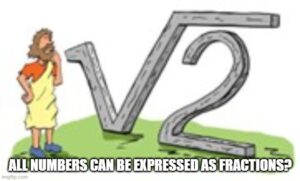

A great mathematician? Well, yes he was. At bottom he was a dangerous mystic with anger management issues. If he even existed, which is a matter of debate. And don’t let’s get too Western-centric with maths. Chinese π was calculated by Zu Chongzhi in the 5thC as 355/113, which is massively more accurate than 22/7. Not that the Greeks really thought that π WAS 22/7. Archimedes showed that it was a number between 22/7 and 223/71. The sudden death of the latter at the hands of a Roman soldier is, in a way, horribly symbolic of what the Greeks might have achieved had the Romans not conquered them. Rome was too powerful for Greece; but the Romans lacked intellectual curiosity. (All except for Lucretius, whose De Rerum Natura really is both original and thought-provoking. Descartes pinched ideas from him.) Under the Roman imperium the Greeks continued to amaze the world; but it could have been so much more.
The West has been immeasurably indebted to this strangely prodigal people. The two biggies were Plato and Aristotle. The latter was a genius, still worthy of honour and respect. (Although he was wrong in a number of areas. Nevertheless, it was a beginning, and a very good one.) The former was an utter disaster. He began by making up fairy-tales about Socrates. Then he went on to create an imaginary perfect city-state. Utopia has inspired many of the worst Western philosophers. The term was devised by the sainted Thomas More, who described a Utopia every bit as unconvincing as Plato’s frightful Republic. Plato also created the calamitous idea that the material world was like shadows on the wall of a cave. What we see is not real. Reality is elsewhere. He put this into the mouth of Socrates, who may indeed have said it.
What Socrates probably meant by it was that we should attempt to free ourselves from our delusions. What Plato’s followers – who were far stupider than he was – seem to have taken from this allegory was the calamitous idea that Up There In Heaven everything is perfect and dances in circles. Down here, nothing is real: mere temporary shadows reflecting transcendent verities. And thus were Forms created. Forms being ideal, eternal verities; while everything we perceive is merely their shadow on earth. And no, this doesn’t end well.
The next step on the road to perdition was put there by René Descartes, a man who spent too much time in bed labouring under the hallucination that he was thinking. It is perhaps unfair to put him in this rogues’ gallery at all. His was one of the most brilliant minds ever to inhabit this world. He was a first-rate mathematician and scientist. Much of modern scientific thought was largely invented by him, including algebraic notation. He taught that animals are machines; and that nature was made from tiny particles obeying a small number of fundamental laws.
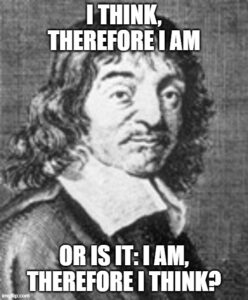
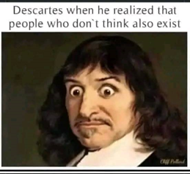
He laid the groundwork which made the Newtonian revolution possible. And he was a devout Christian who solved the problem of science vs metaphysics by postulating that mind and matter were two different things. He was intelligent enough to be troubled by the implications of this; and spent much of his Meditations trying to reconcile its contradictions. Had he thrown his neo-Platonic baggage overboard it would have saved him a whole world of trouble. As it was, he created the possibility for Immanuel Kant to have his Enlightenment-Religious cake and eat it.
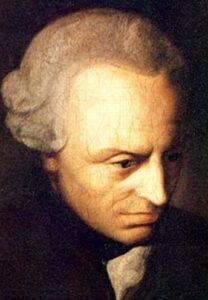
Immanuel Kant was another thinker who was a brilliant mathematician. He built on the English Enlightenment of Francis Bacon and John Locke. Yet, being German, he wanted a Theory Of Everything. He tied himself in knots describing the difference between synthetic and analytic knowledge; and a priori and a posteriori judgements. Where this eventually led was a decision that religion lived in a separate box from science. English empiricists don’t trouble themselves with this stuff. It leads to dangerous consequences. See later on.

Enlightenment and Counter-Enlightenment
France’s ancien regime was so paralyzingly awful that reaction against it was inevitable. Denis Diderot thought he could solve mankind’s problems by making an enormous encyclopedia which would be the repository of the world’s wisdom. Which was at least a nice try. Charles, Baron Montesquieu, was a more far-sighted philosopher. It was he who coined the term Separation of Powers. And a fine idea this is, since he predicted ruin and calamity for societies in which all power was centralized. Such as for example 18th century France. Sane societies do not allow the same people to run the Church, the government, the judiciary, and so forth. Especially not the Church. Church and state must be kept separate. The most brilliant and far-sighted of the French philosophers of this age was Voltaire. He was a gifted writer already before the Lisbon earthquake shattered the Utopian dreams of his colleagues who fondly imagined that the world was peacefully progressing towards a state of Enlightenment. Candide was his riposte to the daydreams of his confrères. It’s an uncomfortable book. If you want cheerful comedy, read Micromegas and Zadig instead.
But Voltaire’s chief contribution to European thought was his Three Freedoms: freedom of religion, freedom of speech, and the separation of church and state. The lattermost he borrowed from Montesquieu. The other two were his own idea. They did not exist in France. But he had been to England, and observed them for himself. He admired the constitutional monarchy he saw there, and told anyone who’d listen how much better it all was that the despotic rule of the priests and the Bourbons. The really important thing about Voltaire’s championship of freedom was that it wasn’t abstract, neo-Platonic moonshine. They have these things in England! They work! I want them here!
He also wrote that the human brain is a complex organ with the wonderful power of enabling man to find reasons for continuing to believe whatever it is that he wants to believe. He had no time whatever for canting nonsense, least of all from Rousseau:
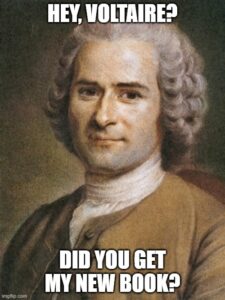
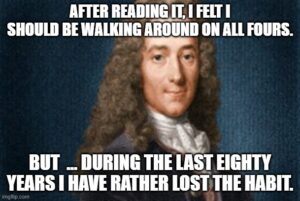
Is the personal also the political? Compare these two. Rousseau repeatedly impregnated his illiterate mistress and disowned the children she bore him. Voltaire’s girlfriend? Émilie du Châtelet: linguist, scientist and all-round genius. He encouraged her studies in the face of official disapproval. To whom would France hearken? Obviously the tub-thumping misogynist, because emotion trumps reason most days of the week. He wanted to tear down the ancien regime and replace it with Nature worship, whatever that is. Unfortunately, he got his wish.
Louis XVI was one of a long line of delusional monarchs who imagine that they can ride out a storm with duplicitous manoeuvrings. He got his head chopped off. Europe invaded France; and the French armies, set into motion by the genius of Lazare Carnot, proceeded to devastate all Europe. The rise of Napoleon was more or less inevitable. People still romanticise this unthinkable monster, for reasons best known to themselves. The British, who had initially welcomed the Revolution as an overdue correction, soon realized that there was nothing for it but war to the knife until the dragon was slain. The war against Hitler lasted six years. The war against the French lasted twenty-two. Millions died in battle. Millions more were tortured to death by the rampaging savages of the Revolution.
And what was the conclusion of philosophers? Why, that counter-revolutionary Europe had despicably triumphed against the noble forces of reform. Thus was set in motion the vilest of heresies: that philosophers should collaborate with tyrants in the interests of some supposed Greater Good. It is the gospel of Saruman. It raged until well into the twentieth century. You will still hear it today in the forsaken academies of Humanities departments. Martin Heidegger gave lectures in his Nazi uniform. Paul de Man openly collaborated with the Gauleiter of Belgium. Thinkers who ought to have known better collaborated with the Soviets. Michel Foucault’s pernicious influence is still with us. He openly praised a deranged murderer and announced that Pierre Rivière’s story ought to have been written up by Plutarch. He was obsessed by sex, violence and power. Jean-Paul Sartre made famous the idea of engagement: that smoking Gauloises and wearing berets might result in the dictatorship of the proletariat. That’s when he wasn’t humiliating his girlfriend Simone de Beauvoir (no great shakes as a philosopher, but miles better than he was) and writing hideous books about despair and nausea.

Some of the more recent philosophes were barking mad. Like Jacques Lacan, who famously announced that the square root of minus one was the erect male penis. (An early example of the science-envy of alleged social scientists. And look: just stop it. If you want to be scientists, learn some vector calculus first. Stop pretending!) Some were wilful obscurantists, like Jacques Derrida. Roland Barthes famously proclaimed the Death of the Author, since everyone recreates a text as they’re reading it. It didn’t stop him writing books which still had his name on the cover. Now, alas, he seems almost sensible, compared with this recent comment on Facebook:
We have the term “reader-response theory” for the idea that the meaning of a text is (re)created by those who read it. We now need a term for the idea that the meaning of a text is created by those who don’t read it, and that this meaning is somehow truer than the meaning created by either the writer/s or the reader/s of the text.
Ouch. (And yes, the writer *was* being sarcastic. But this deranged process is all too common. Much of the reactionary tub-thumping on cable TV comes under this heading.) And all too many were power-crazed, like Antonio Gramsci, who incited his followers to Capture The Culture. They briefly managed to infiltrate the West’s humanities departments and fill the ears of students with postmodern nonsense. Ironically for them, the bureaucrats and managerialists then captured the culture of universities and turned academic staff into ill-paid helots. As a standing reproach to the collaborators, consider this man:

Albert Camus has been over-praised. L’Étranger is not a terribly good book. That which is good in it was borrowed from Stendhal’s Le Rouge et le Noir. But La Peste is a clarion call to all French intellectuals. No, it really isn’t about bubonic plague. I think we all got that. It’s about heroism in the face of calamity. And collaboration. After the war, the Nazi collaborators who weren’t caught slipped quietly back into their old lives. Complacency, collaboration, and devil’s bargains are the enemies of France. The quiet courage of Dr Tarrou must be our watchword.
And here, for your general admiration, is a statue – one of many – of one of France’s greatest wartime heroes:


Jean Moulin was a Resistance leader who was captured by the Gestapo. He was tortured, and refused to reveal any of their secrets. He died in 1943, but he lit the flame that burned through the War to its successful conclusion. He is remembered with honour throughout France, as he should be. For balance, I have also put in a teenage girl who doesn’t have any statues. Yet. Even the French, who weren’t big on female empowerment at the time, rewarded her dauntless exploits with a commission as lieutenant. One Jean Moulin, or one Simone Segouin, is worth more than all our latter-day philosophes combined.
Mimesis and Bad Religion
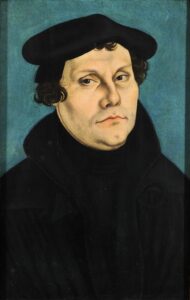
In 1518 Martin Luther nailed his celebrated ninety-five theses to the church door in Wittenberg. Or possibly he didn’t. The legend of Luther has become a panoramic canvas on which scholars and divines alike have filled in the dots as they pleased. The best account of him I know comes from the New Yorker:
https://www.newyorker.com/magazine/2017/10/30/how-martin-luther-changed-the-world
Luther was an accidental Protestant. Most of his legacy is horrifically destructive (anti-Semitism, Peasant Revolts, the Thirty Years’ War and the like). What is beyond dispute is that he gave the world the concept of Homo Solus: the individual as a creature with full agency. He did not intend to do this, but his idea (one of many obsessions in his life) that salvation came from faith alone has echoed down the centuries. It still rages out of control today. He believed that good works followed from faith; though that part is less influential now. But he created the possibility that everybody could have their own personal religion, in which they could say and do anything they liked so long as they could find it in the Bible.
Worse was to follow in Geneva:
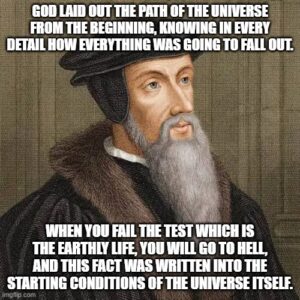

The frightful conceit was born that God’s Elect are predestined to salvation, while others are not. Please compare this at your leisure with Origen’s notion that eventually all souls would attain Heaven, with the possible exception of Satan. And Calvin was also responsible for this heresy:


Calvin achieved this in his uniquely horrible city-state of Geneva by banning pretty much all pleasures except money-making. You cannot earn your way into heaven through good works? So what is the point of them? Perchance we should simply sit back and admire our own rectitude? And thus was self-righteousness given sanction. It rages throughout the West to this day.
Protestantism’s severest critics nowadays may be found among the fashionable. This is hardly surprising, since they are born of a similar sensibility. Neither are good nor bad in themselves. By their fruits you shall know them. The fashionable have self-flagellation and Inquisitions:




Ninety minutes into a compulsory seminar most humans find they have lost the will to live. Fortunately the side-effects are temporary, and normality resumes after a cup of tea and a lie-down. Apostles of White Fragility and the like have yet to learn that indoctrination seminars have no measurable effect on human behaviour. But that really isn’t the point. The essential acts of fashionable thought are mimetic. Policing of speech is its most obvious manifestation because it costs nothing. It is mere virtue signalling. When we look at Protestantism Triumphant, virtue signalling is its most glaringly obvious manifestation. The fashionable may be roused to instant fury by such accusations. A fair response is Look Who’s Talking??
The riposte is just. Of course it is. Happy-clappy politicians do little else. Virtue signalling – or Pharisaism as we used to call it – is the curse of the modern age. It seems everyone does it. Inept, corrupt and incompetent governments signal virtue to their adherents as a substitute for meaningful action. The mimesis of virtue takes the place of actual goodness. And down the postmodern slippery slope we go. The central problem is the privileging of emotion over reason. This has become associated with postmodernism, although it did not have to be like that. But an enormous amount of joyless name-calling is nothing more than performative outrage on behalf of nobody in particular. Who is being helped by any of this? Why, no-one. But that isn’t the point. Mimesis of virtue is the point. Because it costs nothing, and gives a factitious warm inner glow. Politics becomes merely a vehicle for personal therapy.
A word of warning here. Do not assume that everybody who has fashionable opinions doesn’t actually follow through and Do Things. An issue at random: We Should Do More For Refugees. I know folks who not only donate money to help the needy. They have taken refugees into their own homes. Any time they want to lecture me on this topic, I sit up straight and pay attention. The sterile desert plains of moral vanity are now receding into the distance. Salvation by works? It beats the alternative every day of the week.
What Postmodernism Tells Us
Art, and thought, progress through the phases of realism, modernism and postmodernism. The best and most incisive postmodern philosopher was Jean Baudrillard, who actually took it seriously:
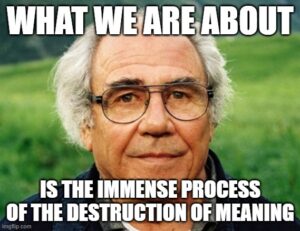
He also famously wrote that it is impossible for anything now to happen which has not already happened on television. Baudrillard’s Theory of Simulacra is a useful tool for decoding these bewildering days. Here it is, describing the process of abstraction using meat:


Meat comes from animals. Early societies all knew this. In an urban society, however, people think meat comes from butchers. Abstraction has now begun.


Tofu replaces meat without actually denying that meat exists. It’s another level of abstraction. The object at right comes perilously close to denying the very being of meat. We are now approaching Baudrillard’s Precession of Simulacra:

The reality of meat is now abolished. This object only exists to be sung at by close-harmony Vikings.
That we live in a postmodern world – at least in terms of pop-culture – is an unfortunate fact of life. The Kardashians and their ilk are not explicable on any other terms. What is it they do, exactly? No-one knows: but that’s not the point. They are mere simulacra: images emptied of all meaning, and dragooned into the service of making vast amounts of money for doing nothing much at all. What began with what we are advised are actual humans underwent precession until the real humans quietly slipped away and their images were left to parade along imaginary catwalks. Perhaps their originals play concert harps and compose haiku. No-one knows, and it doesn’t affect their carefully-tailored image in any way. The critical distance has evaporated; meaning has been finally abolished; and nothing is left but a fashion parade of empty semiotics.
Now all of this was clever enough in its way. Academics fell in love with it, partly because it was – in its beginning – fun and playful. It isn’t all that sound. But the real reason they loved it is because it gave them a Kantian trapdoor wherein to indulge themselves with their favourite delusions. As Kant built himself his own little fantasy realm wherein his religion could be true without contradicting science – which appeared to him to be falsifying religion – so the ivory tower brigade realized that their fantasy world in which to play Pretend had now been enabled. If there is no objective reality, then we can make it all up as we go along.
It is a terrible trap. Orthodox Marxists were horrified, since Marxism is a modernist creed and stands or falls by its relation to actual events. You don’t get to make things up! Yet they went ahead and did it anyway. Postmodernism has generally played Iago to the West’s Othello, as Stephen Hicks tells it. It need not have been like that. But that is what it became. If you wish to study PoMo, then read Baudrillard, and stay well away from Foucault and his noisome ilk.
Baudrillard on America:
‘We criticize Americans for not being able either to analyse or conceptualize. But this is a wrong-headed critique. It is we who imagine that everything culminates in transcendence, and that nothing exists which has not been conceptualized. Not only do they care little for such a view, but their perspective is the very opposite: it is not conceptualizing reality, but realizing concepts and materializing ideas, that interests them.’
Now this is reasoning of a high order, well beyond the prefabricated platitudes of the fashionable. To see modern Americans building metaphysical castles in mid-air is a sad commentary on the decline of the USA as a refuge of sanity. We can see this deterioration mirrored in the film and television industry. Once upon a time Americans were able to do this more or less competently. What we see now is vast amounts of money squandered on vanity projects. Take Rings of Power, straight out of Morgul Studios. You would have thought that nobody could be bored with Middle-Earth. But they managed it. Foundation suffers from the same disease. Here’s how it works:
- We know much better than the original author. Forget their ideas. We’ll make new plots.
- Spray the screen with CGI.
- Diversity casting will fix everything.
- Forget plot arcs and character development. Just make all the men weak and stupid, and all the women Mary-Sues.
Mix these fetid ingredients together and you can reduce great writing to gibberish. And not just ordinary gibberish. Boring, tedious, unwatchable gibberish at that. Watching young women of colour attempting to make sense of a thoroughly putrid script fills the viewer with sorrow. These folk may well be good actors. Why not give them a script they can make something of? Not that wrecking classics is anything new in America. Walt Disney’s treatment of Winnie the Pooh, The Wind In The Willows and The Jungle Book was a crime against humanity. But at least Disney knew better than to bore his audiences to death.
The central problem with postmodern vapouring is that when words are emptied of meaning, they become slogans for protection rackets. The 2024 COP summit in Baku was a brazen example. Really? A dictatorial petro-state is lecturing the world on abandoning fossil fuels? Delegate after delegate gave the game away by calling on the embattled West to subsidise their decarbonisation to the tune of trillions of dollars. The spectre of colonialism – another term now bleached of all possible meaning – was dutifully raised. The West must feel guilty because they did bad things in previous centuries? Right, goodness, is that the time? Renewable energy is the cheapest form of power on the market. Embrace the market and shun the talkfests.
Where PoMo Ends Up
Postmodernism is not the stable endpoint that academics used to pretend a generation or so ago. Five eventual destinations are currently popular: surrealism, Lyotardism, the Rampaging Id, secular Gnosticism and sacred Gnosticism. Let us outline each of them in turn:
- Surrealism doesn’t actually go anywhere. Melting clocks and burning giraffes may be amusing, thought-provoking, thrilling or enlightening. But nobody goes home from an art gallery and fills their bathtub with plastic elephants. Well, hardly anybody.
- In an essay entitled: A Reply to the Question: What Is the Postmodern? Jean-François Lyotard theorized that we must take a refreshing plunge into the cold waters of scepticism and enjoy the delightful sensation of having all our shibboleths washed away. If this sounds like colonic irrigation, it should. The Grand Narrative of truth, science, legitimation, Hegel and the Western colonial narrative must go. What did he bring to the table in its place? Difference of opinion. And yes, it’s complicated. This is where Commodification comes in. And Binary Splits between the sublime and the pornographic in art and literature. And where do we go after that? Don’t Do Porn. Well, porn isn’t real anyway. Try not to obsess about it.
For students of cultural theory, Lyotard’s writings bear an eerie resemblance to the quaint imaginings of FR Leavis and his fellow-Scrutineers, who proclaimed that there were five great English novelists whose works were chiefly distinguished by their greatness. Bien, M. Lyotard? Which trouser-leg do we choose in our binary split? How will we know whether we are being sublime, or merely pornographic? Well, you’ll know it when you see it. Yes, that’s pretty much it. It also echoes Roland Barthes’ convenient dichotomy that anything Left that I like goes into the box labelled Progressive, and anything Left that I don’t like goes into the box labelled Stalinist. Logic? Reason? They’ve been washed down the plughole long ago.
- The Rampaging Id is what happens when you take a similar cold bath to Lyotard’s and decide instead that what has to be washed away is the entire liberal Enlightenment project. This consequence was enabled by postmodernism, and let loose a tidal wave of raw emotion. Counter-Enlightenment, here we come! It is the grand narrative of Jean-Jacques Rousseau and it has captured almost the entirety of the USA’s Republican Party. Under the regime of Horus the Crowned Child all the worst excesses of French collaboration with tyranny were multiplied, and glorified. The ascent of an unscrupulous con-man to the White House is only explicable under these conditions. His fan base was ready to accept the most grotesque falsehoods, excuse the most appalling misdeeds, and palliate the most bizarre accommodations with tyrants.
The other main tranche of dribbling nonsense fuelled by the over-privileging of emotion resides in curious objects like Settler-Colony Theory. This oddity arose from the writings of Frantz Fanon as a metaphysical trapdoor for the old-school agit-prop doctrine of Necessary Violence, and was invented to delegitimise Israel and help with the extermination of all Jews everywhere. This was then also applied to Australia in an attempt at delegitimising us. Rhetorical overreach like this is bound to be massively counterproductive, naturally. Not that these folks care. It’s all about the therapy. Pro tip: the only country in the world which isn’t a settler colony is Iceland. I’m not sure where that gets you, if anywhere; but I look forward with interest to hearing demands that all Angles, Saxons and Jutes should be repatriated from England to Germany and Denmark. Or perhaps that all Indo-Europeans should be sent back to central Asia. Good luck with that.
- Secular Gnosticism. James Lindsay calls this ‘scientific gnosticism’, though early in his article he backpedals and changes it to ‘scientistic’. I’d call it secular Gnosticism. It is a combative article, as you would expect from a soi-disant Professional Trouble-Maker. Just because he’s spoiling for a fight doesn’t mean he’s necessarily wrong. Here is his payoff line:
The essence of Gnosticism can be expressed in three beliefs…
- That it is not you or your theories that are wrong, but the world itself.
- That we have been flung into this miserable and intolerable condition against our wants; but…
- [We] are able to attain a consciousness, a knowledge, a Gnosis – that will allow us to repair the world and ourselves.
Yes, he’s a culture warrior. But does not this description meet the bill? For the fashionable the man is at the very least a formidable enemy. He steers well clear of the Cultural Marxism rabbit-hole. (Don’t go there. Really.) It isn’t Marx but Hegel who dreamed up this idea of The Imagined Future to which the present must be sacrificed. But its ancestry goes back to Kant, More and beyond to Plato and his bloody awful Republic. Lindsay knows or guesses much of this. By destroying the idea of an objective reality – or purporting to have done so – postmodernism enabled this monstrous game of Let’s Pretend.
For these secular gnostics, WH Auden’s quatrain was all too prescient:
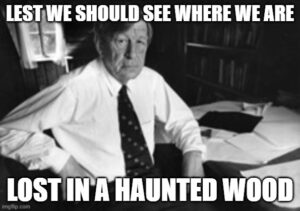

Once you have conceded that the civilization which spawned you is rotten to its core, you really have nowhere to stand; and nowhere to go except some imaginary future in which everyone can dance in circles. We will never be happy until all oppressions have been removed? The Ancient Greeks had a name for that:

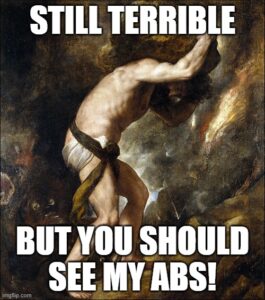
When the stone reaches the top of the hill, it rolls down again. Rinse and repeat. Sensible people pick their battles. But that is just what these poor lost souls absolutely cannot do. Every minor speed bump on the highway of life becomes a battleground. The central problem is because these folks define themselves primarily by what they are not. This never ends well. I call this Sisyphean treadmill Secular Gnosticism, because there are better versions available:
- Sacred Gnosticism. Cultural agitation with a sense that the metaphysical infrastructure we have inherited is a fact that cannot – and should not – be swept away in favour of imagined Paradise. Ideally, with religious faith of some kind. Do please look at the Society of Friends:
The one thing which distinguishes Quakerism from empty gesturing is that they live in the material world. It isn’t Paradise on Earth. Please don’t expect that. But when we see hideous injustices, let’s do something about them. Friends don’t expect thanks. Friends, they tell us, Are Not Thanked. But they help make a better world in a million small ways.
But … it really is a long way through to get to The Other Side. This is why Humanities are so friendless nowadays. People who haven’t gone through indoctrination sessions don’t need to slog through all of this stuff. The above guide is intended for those who have finished their cultural studies courses, or else are marooned halfway through them and wondering when they will touch bottom again. It may also be useful for those who have allowed themselves to become addicted to certain news channels. Especially those who specialise in confected outrage about straw man matters. Polite society requests that you argue in good faith. You do not have to go Full Quaker. I am not asking anybody to remain silent in the face of injustice. Racism is real. So are many other abuses. In a polite society these things are not acceptable. How it should probably go, in a well-mannered community, is something like this:


With a brighter offender, a trailing ellipsis might be sufficient. Tall people found your post highly offensive. If you got defriended, you probably have form. Consider your audience before emoting loudly!
Manners really are important. A quiet word in the background can be far more potent than a stump speech. The important distinction is between empty gesturing and actually doing something. We don’t hear much about the Freedom Riders these days. They were quiet heroes. Some were martyred for the cause of Civil Rights. Sadly, it appears it is all to do again in the USA. I wish them all the luck in the world. They will need it all, and more.
Afterword: The Postmodern Messiah

It is not worth wasting too many words on this vacuous nincompoop. How the hell did this even happen? PJ O’Rourke – a sane lifelong Republican – wrote a book with this very title:


PJ’s writings tend to be on the feral side. But his great virtue as a functioning human was one his fellow-Republicans have abandoned. PJ was intellectually curious. He was interested in his fellow-humans, and wanted to know what made them tick. He wrote with insight and illumination about other lands because he went there, made friends, and talked to people. They don’t do this any more in Team Red. Behind the Republican mass insurgency, instead of reason, thought and logic we now have Dogbert’s seminar for the clueless. He told them that all their problems were caused by invisible people named Juan and Cindy. All you have to do is find them and kill them. The search for Juan and Cindy continues. (It is indeed ironic that Scott Adams – once the scourge of clueless and annoying managers – went full MAGA. His decline and fall in his later years might have been written by Euripides.)
Why Donald, rather than any other? I suspect it is because he is that ultimate rarity: a man without a single redeeming feature. He isn’t the new Hitler. Mussolini? Possibly. Brezhnev? Definitely. And Kaiser Wilhelm II. Trump is a man of vanity and sawdust. He has no class, no self-control, no empathy, no intelligence beyond rodent cunning, no oratory, no curiosity, no loyalty to anyone but himself, no willingness to listen, no executive ability, no morals that anyone has ever unearthed, and no sense of humour. He doesn’t even know what a joke is. He lies without shame or stint. He admires dictators because he wants to be one. According to his idolaters he is King David of Israel. Where is Nathan the Prophet to rebuke him? Not in the slavering ranks of latter-day Republicans. He is replacing the civil service with yes-men, flunkies, delusional nitwits, juvenile delinquents and Stepford wives. He will send America into bankruptcy and encourage his fellow dictators to overrun and conquer the Free World.
And that, dear reader, is the end result of the postmodern project. Speaking truth to power? Hardly. There is no truth. There is no objective reality. Everything is constructed. By the by, lots of people voted for Donald because of his, and I quote: ‘superior economic expertise.’ If you can imagine a chimpanzee on crystal meth trying to fly a 747 while air traffic control is staffed by drunken clowns with scorpions in their underpants, you’ll have some idea of what the terrified passengers are currently enduring. This is called Cargo Cult Economics. Make a giant papier maché statue of Donald’s hairpiece and the cargo will return to America. It is certainly embarrassing to see this Soviet takeover of what used to be a more or less functioning democracy. It is even more painful to witness senile dementia as a spectator sport.
Yet even when The Donald’s brain, such as it is, was capable of something more than total cognitive surrender, he was still a thoroughly awful person. His true nature actually rhymes with Trump. There used to be a cartoon called Tumbleweeds set in the mythical Old West town of Grimy Gulch. It has not aged well. Not even Hollywood has attempted a movie version, and that is saying much. The mayor is a self-absorbed, cigar-chomping figure called Judge Frump. He boasts that he cannot be bought, but is open to rental fees. In one cartoon he muses on the town’s unpleasing name. His three suggestions are Frumpburg, Frumpton, and Frumpville. Sound familiar?